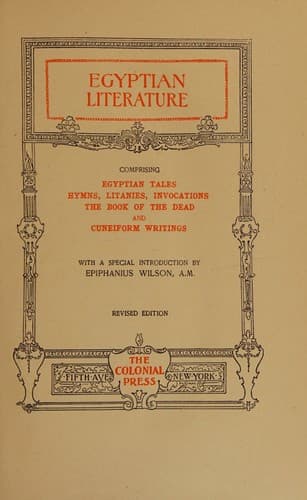
Egyptian Literature: Comprising Egyptian tales, hymns, litanies, invocations, the Book of the Dead, and cuneiform writings
Religion
Egyptian Literature: Comprising Egyptian tales, hymns, litanies, invocations, the Book of the Dead, and cuneiform writings
Egyptian literature -- Translations into English
58 B.—This is a large and important tablet, but much broken; it begins
with a short salutation, and then says at once, “I am laid low.” It refers
to the loss of the city _Abur_,(234) and mentions the names of _Aziru_ and
_Abdasherah_, and says there is no garrison. The enemy are marching on to
the capital. He says: “I sent to the palace (or capital of Egypt) for
soldiers and you gave me no soldiers.” “They have burned the city _Abur_,
and have made an end in the sight of _Khamu_ my son.” “The man of sin
Aziru has marched ... he has remained in the midst ... I have despatched
my son to the palace more than three months (ago) who has not appeared
before the King. Thus (says) my chief of the city of _Takhida_(235)—they
are reaching him: of what use are the fortifications to the men left
therein?” “The chief who came out of the lands of Egypt to inform, whom
you announced us on account of _Aziru_ formerly, I shall send to the King.
You will not have heard this message as to the city _Abur_. The dogs are
wasting, as is said, do you not mark the news? If the King had thought of
his servant, and had given me soldiers. ..” The next passages are much
damaged, but refer to the same general subject of complaint. The next
intelligible sentence is: “The people have been enraged expecting that the
King my Lord would give me for my chief city corn for the food of the
people of the strongholds.” He then protests his good faith, and says
finally: “And my sons are servants of the King, and our expectation is
from the King ... The city is perishing, my Lord has pronounced our death
...”
77 B.—After a short salutation: “Let the King hear the news of his
faithful servant. It is ill with me: mightily fighting, the sons of
_Abdasherah_ have striven in the land of the _Amorites_. They had subdued
all the land of the city of _Simyra_, and they have wrecked the city
_Irkata_ (Arkah) for its ruler. And now they are coming out of the city of
_Simyra_, and it is ill for the ruler (who is) in face of the foes who
come out.” The tablet is here broken, but refers to _Gebal_ and to the
rulers _Zimridi_ and _Yapaaddu_. The writer hopes for the arrival of
troops. “Egyptian soldiers; and the Sun-King will protect me. Friendly men
have been (shut up?) in the midst of his land. Moreover, the King my Lord
shall hear the message of his servant, and deliver the garrison of
_Simyra_ and of _Irkata_: for all the garrison have ... out of the city
_Simyra_ and ... Sun-God Lord of the lands will order for me also twenty
(companies?—_tapal_) of horse, and, as I trust, to the city of _Simyra_
(to defend her) you will speed (a division?) instructing the garrisons to
be strong and zealous, and to encourage the chiefs in the midst of the
city. If also you grant us no Egyptian soldiers no city in the plains will
be zealous for thee. But the chain of the Egyptian soldiers has quitted
all the lands—they have disappeared to the King.”(236)
Public-domain text, read in full here on John Shaqi.
Reviews
Reviews
No reviews yet
Be the first to share your thoughts on this work.
Elsewhere in the archive
Join the Discussion
Join the discussion
Sign in to leave a comment or review.
Sign InorCreate an account