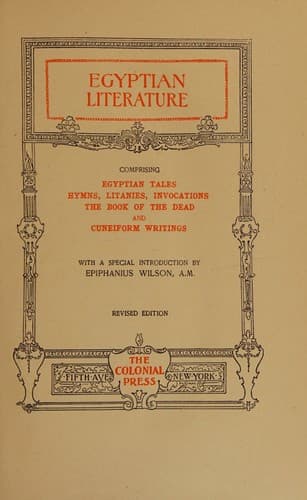
Egyptian Literature: Comprising Egyptian tales, hymns, litanies, invocations, the Book of the Dead, and cuneiform writings
Religion
Egyptian Literature: Comprising Egyptian tales, hymns, litanies, invocations, the Book of the Dead, and cuneiform writings
Egyptian literature -- Translations into English
20 B. M.—“_Ribadda_ sends to his Lord the Great King, the King of many
lands to the prosperous King. Baalath of Gebal has confirmed the power of
the King my Lord. At the feet of my Lord the Sun seven times seven times
he bows him. A petition has been made long ago, made for the city of
_Gebal_, to despatch _Bikuru_ (to the) chiefs of the Land of _Egada_(268)
... served me, which ... I ... three of the chiefs ... they strove ... the
Land of Egypt ... and ... then the King my Lord ... a sin against....
“If the King my Lord supports his faithful servant; and despatch thou ...
this her chief (speedily?); and we two watch the city for the King. The
King shall send the choicest of thy great men, from among those who guard
him. The three chiefs whom _Bikhuru_ strove to despatch, but who have
fled, (are) _Abdirama_, _Iddinaddu_, _Abdmelec_, these are sons of
_Abdasherah_;(269) and they have taken the King’s land for themselves. He
shall send the _bitati_...”
21 B. M.—“To _Amanabba_ ... (by letter) thus (says) this _Ribadda_ thy
servant. I bow (at my Lord’s feet). The god _Amen_ ... of thy Lord, builds
up thy favor (with) the King thy Lord. Hear ... (they have fought)
mightily, and over the Egyptian soldiers are victorious, and ... to the
Land of the _Amorites_.” The letter becomes too broken to read
consecutively, but refers to the Land of _Mitana_, and apparently to a
defeat of _Yankhamu_. He asks for corn, and speaks of having nothing to
eat, in connection with the city of _Gebal_; and refers to three years of
(dearth?), and to the corn failing.
19 B. M.—After the usual salutation to the King, this letter reads: “The
King my Lord will say that the choicest of thy great men, and the choicest
of thy city that thou hast are among those who guard us. My great men and
(those of?) the city, were formerly men of garrison with me; and the King
asked of us corn for them to eat, from my poor country. But now behold
_Aziru_ is destroying me, and I repeat there (are) no oxen, nor ... for
me; _Aziru_ has taken all. And there is no corn for my eating. And the
chiefs—the _Pakas_—also have been nourished by the cities, exhausting the
corn for their eating. Again: (being faithful), the King shall establish
for me, as men of government, the men of government of their own cities,
the men who at first were with their subjects. But as for me my cities are
Aziru’s, and they long for me, to whom destruction is made by him, who is
a dog of the sons of _Abdasherah_, and either you shall do for us as they
wish, or you shall give orders for us to the King’s cities in these
matters.”
Public-domain text, read in full here on John Shaqi.
Reviews
Reviews
No reviews yet
Be the first to share your thoughts on this work.
Elsewhere in the archive
Join the Discussion
Join the discussion
Sign in to leave a comment or review.
Sign InorCreate an account