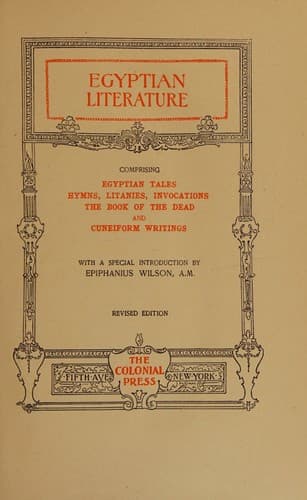
Egyptian Literature: Comprising Egyptian tales, hymns, litanies, invocations, the Book of the Dead, and cuneiform writings
Religion
Egyptian Literature: Comprising Egyptian tales, hymns, litanies, invocations, the Book of the Dead, and cuneiform writings
Egyptian literature -- Translations into English
48 B.—This begins with the usual salutation, and then continues: “If
perchance I send a message to the King my Lord, do not thou refuse the
request of my memorial. Lo! thrice has come upon me a year of storms (or
tumults), and again a year of storms begins. My wheat is naught; the wheat
for us to eat: that which was for sowing for my freemen is finished; their
beasts, their herbs, the trees of their gardens, are wretched, in my
unhappy land. Our corn has failed. Once more the King will hear the
message of his faithful servant, and will order wheat in ships, and his
servant shall live; and be thou moved and send us com. The chiefs (will
send?) horses, as commanded, to _Zu_ ... And thou shalt defend the city
(by so doing?) ... behold _Yankhamu_ says (or asks) ... that wheat be
given to _Ribadda_ ... to him ... corn (the bread of men?) ... and now
with _Yapaaddu_ ... their money henceforth ... ask him, he will tell all
in your presence. Mayest thou know when it is spoken in the presence of
the King my Lord. And this year of storms makes the wheat scarce (in) my
unhappy land ... there was scarcity before in the city _Simyra_, and now
behold in the city _Gebal_.”
The text is here too broken to be read. It seems, perhaps, to refer to the
enemy having possession of the sea, and to the entreaties of _Yankhamu_,
and to certain waters, and the general wretchedness. A paragraph then
begins:(270)
“The King of the Land _Taratzi_(271) has coveted the city of _Simyra_; and
they desired to march to the city of _Gebal_; and none now has urged him,
and he has stayed in his land. Now as he is strong he will send to the
great ... by my wish ... they have returned to us.” The letter is again
much broken; it refers to a ruler, saying: “His heart is with my heart;
but _Abdasherah_ has conquered beyond the land of the _Amorites_, also
since the time of your father the city of _Sidon_ has submitted to the
occupation by his allies: the lands are for the men of blood, so now there
is none who is a friend (or kin) to me. Let the King regard the message of
his servant. Let him give men to guard his city. Is not she insulted by
all the men of blood?”
The latter part, referring to allies, is much broken.
54 B.—This is broken at the top, and considerably injured. It demands
soldiers, and the restoration of the rulers. “The city of (_Sidon?_), and
the city of _Beirût_, the sons of _Abdasherah_ have silenced: they fought
for the King, but the city of _Sidon_ and the city of _Beirût_ are not the
King’s. We sent a _Paka_: he did not desert his duty to you, but she has
rebelled to your face: for it was permitted by the freemen. The men of
blood have seized the city.(272) Behold as for me this is my repetition
... city _Atsar_ ... restraint ...”
Public-domain text, read in full here on John Shaqi.
Reviews
Reviews
No reviews yet
Be the first to share your thoughts on this work.
Elsewhere in the archive
Join the Discussion
Join the discussion
Sign in to leave a comment or review.
Sign InorCreate an account