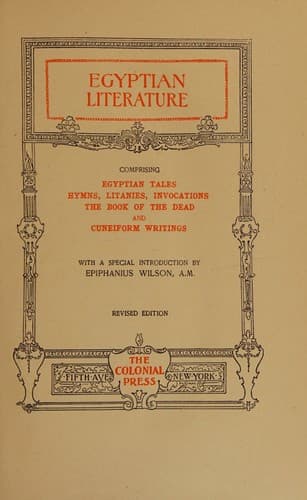
Egyptian Literature: Comprising Egyptian tales, hymns, litanies, invocations, the Book of the Dead, and cuneiform writings
Religion
Egyptian Literature: Comprising Egyptian tales, hymns, litanies, invocations, the Book of the Dead, and cuneiform writings
Egyptian literature -- Translations into English
The only site which seems to be suggested by Pitazza is the important ruin
of _Futeis_, southeast of Gaza. It is near the road to Egypt and in the
plains. The letters probably refer to arrangements for the flight of the
kings of Jerusalem and Gezer, or of their wives.
77 B. M.—A short broken letter by _Satiya_, who was apparently chief of
the city (or chief town) of _Eni-Saam_(_si_), which is perhaps En-Shemesh,
close to Zorah, in the Valley of Sorek, now _’Ain Shems_. It is the
Ir-Shemesh of the Bible (Josh. xix. 41), otherwise Beth-Shemesh (Josh. xv.
10). Here, again, we find an Egyptian station in an open valley, on one of
the main roads to Jerusalem.
133 B.—“To the King my Lord by letter thus (says) the chief of _Kanu_ thy
servant: at the feet of the King my Lord seven times and seven times I
bow. Thou thyself hast sent to me, to muster to meet the Egyptian soldiers
(_bitati_); and now I with my soldiers and with my chariots (am) in sight
of the soldiers of the King my Lord, as far as the place you will march
to.”
This town cannot well be any of the Kanahs of Palestine, since the word
would then be “_Kanatu_.” It is more probably the important ruin _Kanya_,
close to Rabbath of Judah, immediately west of the Valley of Elah;
chariots would be possible in this vicinity.
LETTERS FROM UNCERTAIN SITES
33 B. M.—“To the King my Lord by letter thus (says) _Abd Istar_(?)(363)
the King’s servant. At the feet of the King my Lord I bow, seven times at
the feet of the King my Lord, and seven more, both heart and body. And
this is to show the King my Lord how mightily he fights against me, and
destroys the rulers from the presence of the King my Lord; and the great
King shall give orders for my defenders. Moreover, it sends messages to
the King my Lord as to me, and I shall hear all the messages of the King
my Lord. I will listen. Now ten women (concubines?) I am retaining.”
Perhaps these were some of the ladies on their way to Egypt: “_tumiki_”
seems to come from the root “_wamak_,” an Arabic root meaning “to love.”
The Amorite words with an initial “_vau_” are nearer to Arabic than to
Hebrew or Aramaic. One of the commonest is “_uras_,” “to desire” or “ask,”
whence one of the names of Istar, the goddess of desire.
34 B. M.—Is a short letter broken at the end; it merely acknowledges a
message, and is from _Abd Astati_. There was a deity _As_, or _Ast_,
apparently of Egyptian origin.
60 B. M.—“To the King my Lord my Sun my God thus _Mayaya_.” The important
part of this short letter is broken, but it appears to say: “Have not they
devoured _Yankhamu_ ... this conquest of all the lands from men of blood,
and the devouring of thy land.”
65 B. M.—(_Sibtiaddu?_) writes as a servant of the King with the usual
salutation, and has heard the message. “Behold what _Yankhamu_ (says). I
am a faithful servant at the foot of the King. Let the King my Lord know
it. I guard much the King’s city which is with me.”
Public-domain text, read in full here on John Shaqi.
Reviews
Reviews
No reviews yet
Be the first to share your thoughts on this work.
Elsewhere in the archive
Join the Discussion
Join the discussion
Sign in to leave a comment or review.
Sign InorCreate an account