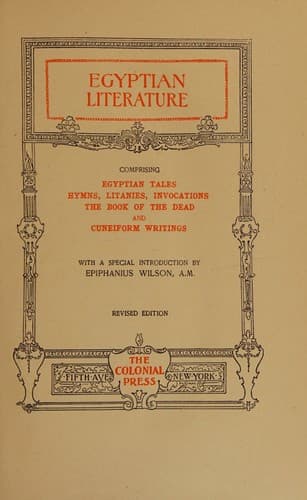
Egyptian Literature: Comprising Egyptian tales, hymns, litanies, invocations, the Book of the Dead, and cuneiform writings
Religion
Egyptian Literature: Comprising Egyptian tales, hymns, litanies, invocations, the Book of the Dead, and cuneiform writings
Egyptian literature -- Translations into English
There is only one place in Palestine called Zabuba; it is the Sububa of
the fourteenth century, the modern Ezbuba, south of Taanach, west of the
plain of Esdraelon. Poor Basmath had to go some sixty miles by road to
reach it from her home. This interesting little letter, which shows she
was not one of the ladies sent to Egypt, though probably a person of
importance, seems perhaps to indicate that the central part of the
country, from which no appeals for help occur in the letters, was
undisturbed. The Amorite-Hittite league came down to Bashan and to Tyre,
but not apparently as far as Accho. The Hebrews, on the other hand, coming
from Seir, are said to have gone as far north as Rimmon and Shiloh, but
were mainly fighting southward from Ajalon. Between the two theatres of
war lay the whole of Samaria and lower Galilee, in which Basmath found a
refuge.
OTHER LETTERS FROM THE SOUTH OF PALESTINE
136 B.—“To the King my Lord (my God?), the Sun from heaven, by letter thus
(says) _Yamirdagan_ thy servant: at the feet of the King my Lord seven
times seven times I bow. I hear the message of the King my Lord to me, and
now I will guard the city of the King my Lord till the coming of a message
of the King my Lord for me.”
Comparing the name with that of Dagontacala of Ascalon, it appears that
this writer was probably a Philistine.
151 B.—A letter from the “Chief of the town _Naziba_” to say he goes with
his chariots and horses to meet the King’s soldiers. This place must,
therefore, have been in or near the plains. It may be the Nezib of the
Bible (Josh. xv. 43), now _Beit Nusîb_, eight miles northwest of Hebron,
close to Keilah. The chariots could easily reach this vicinity from the
plain, by the broad flat highway of the Valley of Elah.
55 B. M.—With the usual salutation, _Ben Addu_, captain of the King’s
horse, says: “Now they watch the land of the King my Lord exceedingly. And
who am I—a dog.... He will hear the messages of the King my Lord and of
the _Ka-pa_ (for _Paka?_) of the King my Lord. To (_Sagusi Khasi?_) ...
thus (says) _Ben Addu_: I bow at thy feet. All is failing. So now those
who are our friends are fleeing to the King; will not he despatch ... the
road.... Now they guard the road: it is cleared for thee.”
56 B. M.—The usual salutation from _Ben Addu_, of the city of _Pitazza_;
continues: “Now they guard the city, and land of the King my Lord, the Sun
from heaven: all that the King has said they watch—the allies. And the
decree of the message of the King my Lord _Bel Anapa_ (Baal Anubis) the
_Paka_ of the King my Lord has uttered. The King my Lord is mighty as the
Sun in heaven. Whom I but a dog, and shall such a one not mind the message
of the King my Lord the Sun from heaven?”
153 B.—From the same _Ben Addu_, of _Pitazza_, with the usual salutation,
and to the same effect as the preceding, but too broken to read.
Public-domain text, read in full here on John Shaqi.
Reviews
Reviews
No reviews yet
Be the first to share your thoughts on this work.
Elsewhere in the archive
Join the Discussion
Join the discussion
Sign in to leave a comment or review.
Sign InorCreate an account