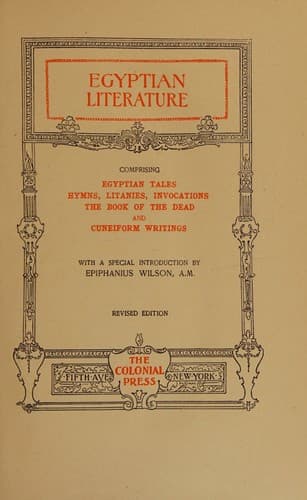
Egyptian Literature: Comprising Egyptian tales, hymns, litanies, invocations, the Book of the Dead, and cuneiform writings
Religion
Egyptian Literature: Comprising Egyptian tales, hymns, litanies, invocations, the Book of the Dead, and cuneiform writings
Egyptian literature -- Translations into English
“And may my brother send untold gold; and may my father’s power increase
with me, as my brother has increased my favor, as my brother has cherished
me much, in the sight of my country, in the sight of the whole of my
brethren. May _Rimmon_ and _Amanu_ appoint that my brother’s wishes be
ever fulfilled; and for myself, my brother, that my wishes may be
fulfilled, as men whom the Sun-God loves. And so now the Gods shall indeed
decree for us this prayer, ... we shall join as friends forever.
“For my brother’s present I have sent to my brother a (double-edged
weapon?) ... and (?) of emeralds, and pure gold ... enclosed in a box, and
... of alabaster, and pure gold, for a box ...”
21 B.—“To _Amenophis III_, the Great King, King of _Egypt_, my brother, my
kinsman(373) whom I love, and who loves me, by letter thus _Dusratta_, the
Great King, King of _Mitani_, thy brother, thy kinsman who also loves
thee. I am at peace, etc.
“To my brother whom I love I have given his young wife.(374) May the
Sun-God and _Istar_ ... her face. As my brother desires: may ... and may
my brother rejoice, in the day when ... the Sun-God and the God ... giving
joy to my noble brother, ... let them grant it to be ... and may my
brother ... forever.
“_Mani_ my brother’s envoy, and _Khani_(375) my brother’s interpreter, as
you cause them to be sent, plenty of (provisions?) I shall give them ...
them much; as they performed their orders I made all the people protect
them. If they do not may my Gods, and my brother’s Gods, guard them. Now I
have sent _Nahramani_ who is careful in my brother’s affairs, and I have
sent (an ornament?) of precious stones—of precious stones and gold, as a
present to my brother; and may my brother be granted to live a hundred
years.”
8 B. M.—The salutation is the same as before, but the writer’s name is
spelt “_Tusratta_” instead of _Dusratta_. The letter is the best preserved
in the whole collection.
“Since your forefathers were friendly with my forefathers, thou therefore
wast very greatly friendly with my father. So you love me: we are zealous
friends. Ten times more you increase it than to my father. The heavenly
Gods shall decree that we shall be friends. May _Rimmon_ my God, and
_Amanu_, so pronounce, even forever.
“And so my brother sent _Mani_ his envoy. Thus indeed my brother (said)
‘Does not my brother’s heart desire that thy daughter (be) the wife of my
young son(376)—as a princess of _Egypt_’ and I spoke as to my intention
about it; and my brother desiring that she should be made ready for
_Mani_, and to show her, so he beheld her, and praised her much. And may
they lead her in peace into the land of my brother. May _Istar_ and
_Amanu_ make her agreeable to my brother’s heart.
“_Gilia_, my envoy, set forth my brother’s message before me. So I heard
and it was very good; and so I rejoiced very much. Thus truly I say ‘This
is thus arranged between us so that we may be zealous friends.’ Now with
firm faith forever let us be friends.
Public-domain text, read in full here on John Shaqi.
Reviews
Reviews
No reviews yet
Be the first to share your thoughts on this work.
Elsewhere in the archive
Join the Discussion
Join the discussion
Sign in to leave a comment or review.
Sign InorCreate an account