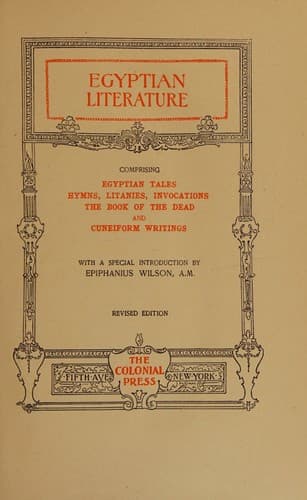
Egyptian Literature: Comprising Egyptian tales, hymns, litanies, invocations, the Book of the Dead, and cuneiform writings
Religion
Egyptian Literature: Comprising Egyptian tales, hymns, litanies, invocations, the Book of the Dead, and cuneiform writings
Egyptian literature -- Translations into English
As this letter is written in what is called by scholars an “unknown
language,” these renderings may be questioned. The dialect appears,
however, to be closely related to the Akkadian and to other Mongol
dialects of western Asia, and to be also the same used (B. 10) by the
Hittites.
10 B. M.—Written, as the Egyptian docket at the bottom of the tablet on
the back states, in the thirty-sixth year of Amenophis III which appears
to have been probably the last of his reign.
“To Amenophis III King of Egypt my brother, my kinsman whom I love, and
who loves me, by letter thus _Dusratta_ King of _Mitani_ who loves thee,
thy kinsman. I am at peace. Peace be to thee, to thy house, to the woman
_Tachikhipa_ my daughter to the wife thou lovest be peace.(385) To thy
wives, to thy sons, to thy Lords, to thy chariots, to thy horses, to thy
army, to thy land, and to all that is thine, be much, much, much peace.
“Thus (I say) _Istar_ of _Nineveh_, the lady of the lands, is kind of
heart to the land of _Egypt_. In the land that I love do not they walk
after her?(386) Do not they cry aloud to her? Now behold it has brought
thee prosperity.
“Now from the time of my father they have besought _Istar_ in her land for
thy prosperity; and, as of old so now, it continues. They honor her.
“And now may my brother receive of her ten times more than before. Let my
brother receive with joy: let it be hastened for him: let it endure.
“_Istar_ is the Lady of Heaven my brother, and as for me let me be guarded
by her for a hundred years; and may great joy be given. Let it be granted
by her that I may not fail; and as you desire may it (befall?).
“Is not _Istar_ my God, and has not she (prospered?) my brother (or been
with my brother?).”
24 B.—The second longest of Dusratta’s letters, 185 lines in all, is
unfortunately very much damaged, as it is perhaps the most important,
giving as it does historical information extending over three generations,
during which the kings of Egypt and of Mitani were allied by marriage.
“To ... _ya_(387) my kinsman, whom I love and who loves me ... the great
King (King of) _Mitani_ thy kinsman who loves thee. I am at peace ... to
the Lady _Teie_ ... to _Tadukhipa_ my daughter thy wife be peace, to ...
be peace. To thy sons, to thy Lords, to thy chariots, to thy horses, to
thy ... and to all that is thine, be much, much, much peace ... of
_Amenophis III_ thy father he sent to me; he explained ... of all that he
sent there was no message at all that I ... to your father as to what he
sent to me; and _Teie_ the chief wife of _Amenophis III_ your mother knew
all of them. All these have been seen by _Teie_ your mother ... the
messages that your father caused to be addressed to me.
Public-domain text, read in full here on John Shaqi.
Reviews
Reviews
No reviews yet
Be the first to share your thoughts on this work.
Elsewhere in the archive
Join the Discussion
Join the discussion
Sign in to leave a comment or review.
Sign InorCreate an account