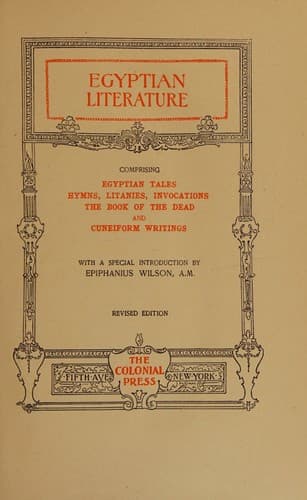
Egyptian Literature: Comprising Egyptian tales, hymns, litanies, invocations, the Book of the Dead, and cuneiform writings
Religion
Egyptian Literature: Comprising Egyptian tales, hymns, litanies, invocations, the Book of the Dead, and cuneiform writings
Egyptian literature -- Translations into English
“Now as to the gifts for my brother: I have sent as my brother’s gifts a
quantity of solid gold, and precious stones: (its value?) includes the
amount of twenty precious stones, and nineteen pieces of gold. The weight
of precious stones and gold remaining includes the amount of forty-two
precious stones and twenty pieces of gold _Zuzas_ of Istar: (this is) the
weight of precious stones and gold remaining; and ten yoke of horses, and
ten chariots, with all that belongs to them, and thirty female slaves.”
27 B.—This is the longest letter in the collection, including six lines in
Aramaic, and 512 lines in Dusratta’s native language (see “Journal Royal
Asiatic Society,” October, 1892, for my translation). The important
passages of the letter appear to me to read as follows, and the meaning is
confirmed by statements in other letters by this writer concerning his
daughter’s marriage. The letter was addressed to Amenophis III, and sent
by the same two envoys, _Mani_ and _Gilias_,(378) already noticed.
“_Gilias_ the envoy, who takes the messages is ordered to utter it, his
duty being to go out, because Amenophis III the Egyptian (ally?) rules a
far off land, and I rule in the city _Ikhibin_(379) the city of the God
_Simigis_(380) the paternal deity.
“To proceed: as _Mani_ my brother’s envoy says, it is understood that my
brother is very desirous that it should be speedily completed.
“Brother, I gladly empower the envoy to take back this woman, whom _Mani_
says my brother commanded him to bring, when he was ordered as an envoy.
“Understanding that my brother desires now to take her home, is it not
necessary, understanding this decision to be preferred; as twenty-three
months have gone by, is not her taking home to be hastened? My Court
having decided to accept, and being satisfied as well as my wife, and
resolved to accept the agreement; and the girl being heartily pleased—how
happy she is words cannot tell—the decision is from the Gods, brother, for
me the decision is from the mighty Gods, my brother. Surely you know
whether I do not desire that she should be so brilliantly exalted, the
girl being so fortunately (married): surely you know that I shall be glad.
“Proclaim thou for me that whatever people of _Khalci_,(381) west of the
_Minyan_(382) country—whatever people of _Khalci_ I have conquered, are
made subject.
“I being the great chief of the power of the land of the _Hittites_ taking
to me, my brother, all the people that are conquered. Let it extend to the
city of _Harran_(383) and let the land possessed by no king be taxed.
“My son-in-law being married in the city of Thebes in presence of the
image of the deity.”
“Is it not thus that _Dusratta_ dwelling afar arranges the marriage of
_Tadukhipa_(384)—_Dusratta_ the favored (friend?) from the Minyan land,
consenting to the wish of _Amenophis III_ the Egyptian (friend) that the
son of _Amenophis III_ be so married to her, in the presence of the image
of the deity.”
Public-domain text, read in full here on John Shaqi.
Reviews
Reviews
No reviews yet
Be the first to share your thoughts on this work.
Elsewhere in the archive
Join the Discussion
Join the discussion
Sign in to leave a comment or review.
Sign InorCreate an account