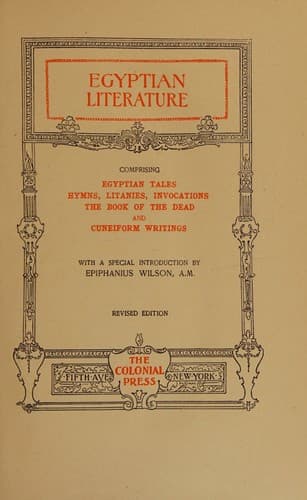
Egyptian Literature: Comprising Egyptian tales, hymns, litanies, invocations, the Book of the Dead, and cuneiform writings
Religion
Egyptian Literature: Comprising Egyptian tales, hymns, litanies, invocations, the Book of the Dead, and cuneiform writings
Egyptian literature -- Translations into English
These inventories of Tadukhipa’s marriage outfit show how far advanced was
the civilization of western Asia in the fourteenth century B.C., and
indicate not only the native wealth of gold, silver, copper, and bronze,
from Asia Minor and the Caucasus, but also a trade which brought jade from
central Asia. The art of the age is similar to that of the objects found
at Troy and Mycenæ, and represented on the Egyptian bas-reliefs, which
give pictures of the tribute from Phœnicia. From other tablets in the
collection we obtain similar information, including the use of ivory, as
also from the records of tribute to Thothmes III in 1600 B.C.
11 B. M.—“To ... Princess of the Land of _Egypt_(407) thus _Dusratta_ King
of _Mitani_. I am at peace: Peace be to thee.... Peace be to thy son;
peace be to _Tadukhipa_ thy daughter-in-law. To thy land and to all that
is thine be much, much peace.
“Thou hast known of me how I loved _Amenophis III_ thy husband, and
_Amenophis III_ because he was thy husband how he loved me. As for
_Amenophis III_ thy husband he heard what I said; and _Amenophis III_
because he was thy husband, sent messages to me; and what he said to thee
my ... both _Mani_ has known, and thou ... hast known all of these
things—the messages we zealously uttered. There was nothing thus that he
has not known of them.
“Now you said to _Gilia_, ‘Say to your Lord, _Amenophis III_ was friends
with your father, and why should his favor be less than to your father?
Nay, indeed, what he shall send to our place shall not ... will not you
hasten to ... your friendship with _Amenophis III_ ... making it greater;
and assure him ... that you will gladly send ...’
“... to your husband friendship ... so now ... your son, ten times more
... and the messages....
“... why from ... our good faith, and ... is given to me ... thus I ...
_Amenophis IV_ (_Nabkhuriya_) ... and now behold ... to give is not....
“... when by your desire I ... and to the presence of _Amenophis IV_ ...
and you wished thus ... do not desire, and ... the treasures of gold to be
remitted, let _Amenophis IV_ receive. (There is nothing, indeed, he may
not desire?) that is not ... ten times more than his father let him
increase in friendship toward me, and in power.”
“... you yourself, your envoys, with the envoys of _Amenophis IV_, with
... let them be sent to _Yuni_ my wife,(408) for what is wished; and the
envoys of _Yuni_ my wife let them be sent to (thee) as to what is wished.
“Now as to thy present ... a goodly stone, also (a coronet?) and a ... of
stones.”
It seems clear from this letter, and from 24 B., that _Teie_ (or _Thi_)
the Queen of Egypt, was related to Dusratta, but it is not clear that she
was his sister. _Gilukhipa_, the sister whom he names, is known from
Egyptian sources to have been the daughter of _Suttarna_, Dusratta’s
father, and she came to Egypt with 317 ladies in her train.
Public-domain text, read in full here on John Shaqi.
Reviews
Reviews
No reviews yet
Be the first to share your thoughts on this work.
Elsewhere in the archive
Join the Discussion
Join the discussion
Sign in to leave a comment or review.
Sign InorCreate an account