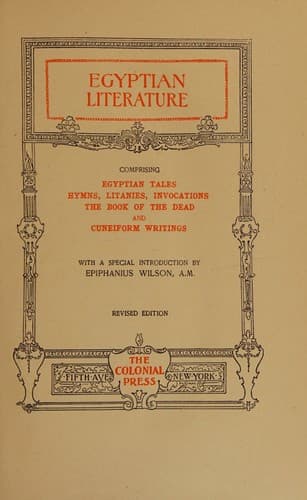
Egyptian Literature: Comprising Egyptian tales, hymns, litanies, invocations, the Book of the Dead, and cuneiform writings
Religion
Egyptian Literature: Comprising Egyptian tales, hymns, litanies, invocations, the Book of the Dead, and cuneiform writings
Egyptian literature -- Translations into English
It is also to be remarked that Dusratta invokes the Egyptian god _Amen_
both when writing to Amenophis III and also when writing to Amenophis IV,
so that there does not appear to have been any change of religion in Egypt
during the reign of the latter—at least, at the time when he wrote.
Amenophis III also married at least one Babylonian princess, as will
appear in the letters that follow.
RIMMON NIRARI’S LETTER
30 B.—“To the Sun God the King my Lord the King of Egypt, thus
_Rimmon-Nirari_(_409_)_ thy servant_. I bow at my Lord’s feet. Lo!
_Manakhbiya_ (Thothmes IV) made my father King ... to rule in the Land of
_Markhasse_ (or _Nukhasse_), and established men to dwell with him; and as
the King of ... was disputing for the kingdom, which has been made ...
which he established for him ... he gave him...”
About twenty lines of the letter are here destroyed; the broken lines
below continue thus:
“And lo! my Lord ... and the King of the land of the _Hittites_ why ... my
Lord the letters ... and fearing ... and lo! the King of _Egypt_ ... and
now my Lord against ... and to the hands ... to our Lord ... thy Lord in
the years that may come.... Do not scorn, since the land was faithful in
service to the King my Lord. And if God commands my Lord to go forth, let
my Lord also send a chief, to be sent up to him with his soldiers and with
his chariots.”
CALLIMMASIN’S LETTERS
1 B.—“To _Amenophis III_ the King of _Egypt_ by letter thus
_(Cal)limmasin_(410) the King of _Carandunias_ (Babylonia) thy brother. I
am at peace. To thee, to thy house, thy wives, thy land, thy chariots, thy
horses, thy ... be much peace.
“Because of the youngest of my daughters, whom you send to wed, _Irtabi_
whom you remember, they took this message. My father formerly sent a
message. You collected many soldiers, you approved his message, and you
sent making a present to my father.
“Now I send thee this envoy. In the sixth year you seek for this, and in
the sixth year you send thirty _manahs_ of gold (instead of?) silver for
my present. I return the same gold. _Casi_ your envoy has known its
(value?) which he has seen. I send thy envoy well instructed as to our
opinion. For I followed ... and the present that he is instructed to ...
is thirty _manahs_ of gold, which you ... a gift of alliance.”
The rest is too broken to read. It mentions five women sent, and ten
wooden chariots—the latter as presents. The next letter is from Egypt.
Either a copy or an original never sent.(411)
1 B. M.—“To _Callimmasin_ King of _Carandunias_ my brother, by letter thus
_Amenophis III_ the great King, the King of _Egypt_ thy brother. There is
peace to my region. To thy region be peace: to thy house, to thy wives, to
thy sons, to thy Lords, to thy horses, to thy chariots, and in thy hands
be much peace. I am at peace. There is much peace to my house, to my
wives, to my sons, to my Lords, my horses, my chariots, my army; and in my
lands there is much peace.
Public-domain text, read in full here on John Shaqi.
Reviews
Reviews
No reviews yet
Be the first to share your thoughts on this work.
Elsewhere in the archive
Join the Discussion
Join the discussion
Sign in to leave a comment or review.
Sign InorCreate an account