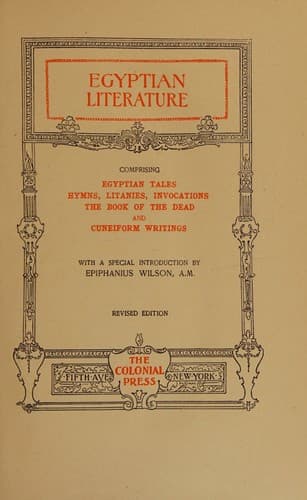
Egyptian Literature: Comprising Egyptian tales, hymns, litanies, invocations, the Book of the Dead, and cuneiform writings
Religion
Egyptian Literature: Comprising Egyptian tales, hymns, litanies, invocations, the Book of the Dead, and cuneiform writings
Egyptian literature -- Translations into English
6 B. M.—“Thus the King of _Alasiya_ to the King of _Egypt_ my brother. Let
him learn: behold I have been at peace, and my land is mighty; and because
of your salutation peace be to you, peace be to your house, your sons,
your wives, your horses, your chariots, your land. May there be much peace
forever, my brother.
“Lo! you shall send to me. Why do not you send your envoy to my city
again; and I heard not. Lo! how much you afflict me, and I am not made
acquainted with all in your midst, and I wonder at this. And now I have
despatched my envoy to your city, and I have also despatched to you, by
the hands of my envoy for you, one hundred (pounds?) of bronze again. And
your envoy carries now gifts—a couch of strong wood, enriched with gold,
and chariots enriched with gold, and two horses, and forty-two (vases?),
and fifty gold (vases?), and two cups, and fourteen pieces of strong wood,
and seventeen large vessels of good make ... from the (?); four (vases?),
and four gold (vases?) ... the gifts of which none ...”
The next thirteen lines are almost entirely destroyed. The letter
continues on the back of the tablet:
“... _Alasiya_ my merchants with thy merchants, and ... with them; and
truly there is good faith ... and my envoy will go to your city, and your
envoy shall go to my city. Moreover, why will you not despatch for me
(unguents and vases?) I (say), and I will order what you wish, and that
which is useful (serving well?) in fulfilment of the decree, I order to be
given thee. Behold you sit on the throne of your Kingdom.”
13 B.—A short fragment, too broken to read, includes the names of the
countries of _Egypt_ and of _Alasiya_, with salutations. It includes a
reference to merchants, and apparently to presents, nine lines in all.
14 B.—The writing and the clay appear to show that this also came from
_Alasiya_. It included twenty-two lines, but is much broken. The following
may be read:
“Lo! as a present to thee I have sent five pieces of copper, three
(pounds) of good copper, one (?), one (weapon?)—a shipload. Also, my
brother, these men of this royal ship ... and as for thee, the ship ...
speedily ... is sent. Thou art my brother. You desire a salutation, and I
have given it to thee. This man, the servant of the King my Lord, does not
he approach before them? and thou, my brother, send him speedily (under
escort?).”
16 B.—The ordinary salutation is much broken, but the writing, and the
clay of the tablet, seem to show that the letter came from _Alasiya_. The
second paragraph mentions countries called _Umdhi_ ... and _Tim_ ...
possibly Hamath and Damascus. The third paragraph continues:
“And now behold why do you ... your fortress more than my fortress; and
who is it that has vexed us? It is the abode of a hundred sons of
violence. So now ... my brother, because of this, the city _Khumme_ has
meditated evil, and if ... why not gather, and ... to preserve, since it
is necessary that they should be protected from what ...”
Public-domain text, read in full here on John Shaqi.
Reviews
Reviews
No reviews yet
Be the first to share your thoughts on this work.
Elsewhere in the archive
Join the Discussion
Join the discussion
Sign in to leave a comment or review.
Sign InorCreate an account