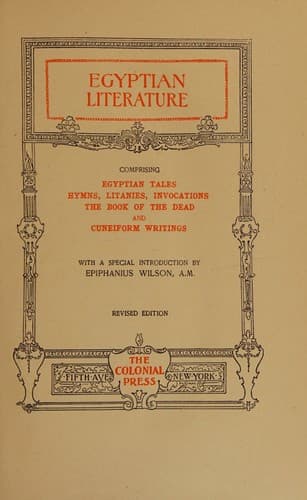
Egyptian Literature: Comprising Egyptian tales, hymns, litanies, invocations, the Book of the Dead, and cuneiform writings
Religion
Egyptian Literature: Comprising Egyptian tales, hymns, litanies, invocations, the Book of the Dead, and cuneiform writings
Egyptian literature -- Translations into English
The remainder, including a note for the King’s scribe, is too broken to
read.
17 B.—A mere fragment, apparently from _Alasiya_, contains a list of
presents, including five wooden thrones (or chairs), objects of silver, a
wooden footstool, and a weight of one _manah_ of some other substance.
CUNEIFORM INSCRIPTIONS AND HIERATIC PAPYRI
Translated by Various Egyptologists
The Great Tablet Of Rameses II At Abu-Simbel
Translated by Edouard Naville
In the great temple of Abu-Simbel, between two pillars of the first hall,
there is a large tablet, which has been added, evidently, a long time
after the completion of the temple. This tablet, which is the object of
the present translation, is covered with a text of thirty-seven lines,
containing a speech of the god Ptah Totunen to the King Rameses II, and
the answer of the King.
It was very likely considered by the kings of Egypt to be a remarkable
piece of literature, as it has been repeated, with slight alterations, on
the pylons of the temple of Medinet-Habu, built by Rameses III. The
tablet, which is decaying rapidly, has been published three times: first,
by Burton, in the “_Excerpta Hieroglyphica_,” pl. 60; then from the copies
of Champollion, in the “_Monuments de l’Egypte et de la Nubie_,” I, pl.
38; and, finally, by Lepsius, “_Denkmäler_,” III, pl. 193. The inscription
of Medinet-Habu has been copied and published by M. Duemichen, in his
“_Historische Inschriften_,” I, pl. 7-10, and by M. Jacques de Rougé, in
his “_Inscriptions recueillis en Egypte_,” II, pl. 131-138.
I am not aware that any complete translation of this long text has been
made. The first part has been translated into German by Mr. Duemichen
(“_Die Flotte einer Ægyptischen Königin_,” _Einleitung_), from the text at
Medinet-Habu; a portion of it is also to be found in Brugsch, “_Ægyptische
Geschichte_,” p. 538. The present translation I have made from the tablet,
which, being more ancient than the inscription, is very likely to be the
original. It contains an interesting allusion to the marriage of Rameses
with a daughter of the King of the Kheta. The inscription at Medinet-Habu,
which is written more carefully than the tablet, and with less
abbreviations, has given me a clue to several obscure passages of the
ancient text.
The tablet is surmounted by a cornice, with the winged disk. Underneath,
the god Totunen is seen standing, and before him Rameses, who strikes with
his mace a group of enemies whom he holds by the hair. Behind the god are
the ovals of six foreign nations, most likely Asiatics: _Auentem_,
_Hebuu_, _Tenfu_, _Temuu_, _Hetau_, _Emtebelu_.
The inscription above the god is as follows:
Public-domain text, read in full here on John Shaqi.
Reviews
Reviews
No reviews yet
Be the first to share your thoughts on this work.
Elsewhere in the archive
Join the Discussion
Join the discussion
Sign in to leave a comment or review.
Sign InorCreate an account