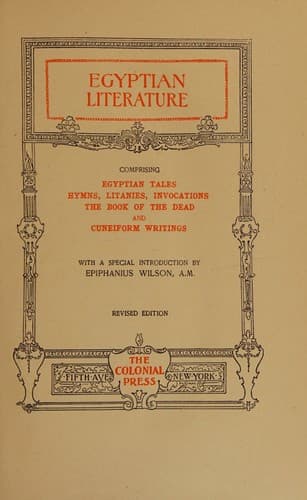
Egyptian Literature: Comprising Egyptian tales, hymns, litanies, invocations, the Book of the Dead, and cuneiform writings
Religion
Egyptian Literature: Comprising Egyptian tales, hymns, litanies, invocations, the Book of the Dead, and cuneiform writings
Egyptian literature -- Translations into English
The “Travels of an Egyptian” has first been translated into English by M.
C. W. Goodwin (“Cambridge Essays,” 1858, p. 267-269), from a hieratic
papyrus in the British Museum, published in fac-simile by the trustees
(Fo. 1842, pl. 35-61). In 1866, M. F. Chabas, availing himself of the
collaboration of M. Goodwin, published a full translation of the same in
French (“_Voyage d’un Egyptien en Syrie, en Phenicie_,” etc., 4to, 1866),
including a copy of the hieratic text with a double transcription into
hieroglyphic and Coptic types, and a perpetual commentary. Objections were
made by M. H. Brugsch (“_Revue Critique_,” Paris, 1868, _Août et
Septembre)._ But M. Chabas strongly vindicated his views in an additional
work, “_Voyage d’un Egyptien—Réponse à la Critique_,” Châlons, 1868, 4to,
since which the matter seems to be settled among Egyptologists. The debate
was, however, unimportant in regard to geographical information, as it
bore merely on the point to ascertain whether the narrative refers to an
actual journey really effected by the Egyptian officer named a Mohar, or a
model narrative of a supposed voyage drawn from a previous relation of a
similar trip extant at the time.
TRAVELS OF AN EGYPTIAN
_Section 1_
18.3 Thy letter which is full of _lacunæ_ is loaded with pretentious
expressions: such is the retribution of those who wish to understand it;
it is a charge
18.4 which thou hast charged at thy will. “I am a scribe, a Mohar,” hast
thou repeated: let us respect thy word and set off.
18.5 Thou hast put horses to the chariots; thy horses are as swift as
jackals: their eyes flash; they are like a hurricane bursting; thou takest
18.6 the reins, seizest the bow: we contemplate the deeds of thy hand. I
send thee back the Mohar’s portrait: and make thee know
18.7 his actions. Didst thou not then go to the country of the Kheta? Hast
thou not seen the land of Aup? Knowest thou not Khatuma, Ikatai
18.8 likewise? how is it? The Tsor of Sesortris, the city of Khaleb on its
vicinity?—
19.1 How goes it with its ford? Hast thou not made an expedition to Qodesh
and Tubakkhi? Hast thou not gone to the Shasous?
19.2 with the auxiliary body? Hast thou not trampled the road of Pamakar
the sky(459) was dark on the day when
19.3 there flourished the cypresses, the oaks and cedars, which reached up
to heaven: there are many lions, wolves, and hyenas
19.4 which the Shasous track on all sides. Didst thou not ascend the
mountain of Shaoua? Hast thou not travelled, thy arms
19.5 placed on the back of thy car separated from its harness by the
horses drawing it?
19.6 Oh! come to ... barta. Thou hastenest to get there: thou crossest
19.7 its ford. Thou seest a Mohar’s trials. Thy car
19.8 is placed in thy hand: thy strength fails. Thou arrivest at the
night: all thy limbs
19.9 are knocked up: thy bones are broken, thou fallest asleep from excess
of somnolence: thou wakest up—
Public-domain text, read in full here on John Shaqi.
Reviews
Reviews
No reviews yet
Be the first to share your thoughts on this work.
Elsewhere in the archive
Join the Discussion
Join the discussion
Sign in to leave a comment or review.
Sign InorCreate an account