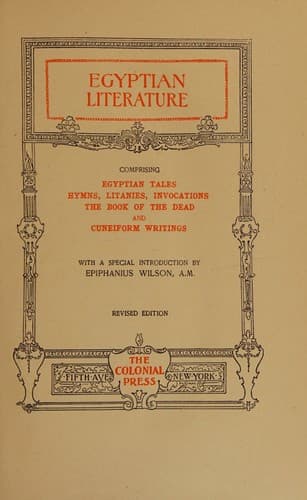
Egyptian Literature: Comprising Egyptian tales, hymns, litanies, invocations, the Book of the Dead, and cuneiform writings
Religion
Egyptian Literature: Comprising Egyptian tales, hymns, litanies, invocations, the Book of the Dead, and cuneiform writings
Egyptian literature -- Translations into English
20.1 ’Tis the hour when sad night begins: thou art absolutely alone. Comes
there not a thief to rob the
20.2 things left aside: he enters the stable: the horses are agitated: the
thief goes back in the night
20.3 carrying away thy clothes. Thy servant awakes in the night; he
perceives the thief’s actions: he takes away the rest,
20.4 he goes among the bad ones; and joins the tribes of the Shasous: and
transforms himself to an Asiatic.
20.5 The enemy comes to plunder, he finds only the wreck: Thou wakest,
dost thou not find them
20.6 in their flight? They take thy baggage. Thou becomest an active and
quick-eared Mohar?
_Section 2_
20.7 I also describe to thee the holy city, whose name is Kapaon (Gabal).
How is it? Of their goddess (we will speak) another time. Therein
20.8 hast thou not penetrated? Come then to Berytus, to Sidon, to Sarepta.
The ford
21.1 of Nazana, where is it? Aoutou, how is it? They are neighbors of
another city on the sea. Tyre the
21.2 port is its name: water is carried to it in barks, it is richer in
fish than in sands.
_Section 3_
21.3 I will speak to thee also of two other small chapters. The entrance
of Djaraou, and the order thou hast given to set this city in flames. A
Mohar’s office is a very painful one.
21.4 Come, set off to return to Pakaïkna. Where is the road of Aksaph?
21.5 In the environs of the city; come then to the mountain of Ousor: its
top,
21.6 how is it? Where is the mountain of Ikama? Who can master it? What
way has the Mohar
21.7 gone to Hazor? How about its ford? let me go to Hamath,
21.8 to Takar, to Takar-Aar, the all-assembling place of the Mohars; come
22.1 then, on the road that leads there. Make me to see Jah. How has one
got to Matamim?
22.2 Do not repel us by thy teachings; make us to know them.
_Section 4_
22.3 I will speak to thee of the towns other than the preceding ones.
Wentest thou not to the land of Takhis, to Cofer-Marlon, to Tamena,
22.4 to Qodesh, to Dapour, to Adjai, and to Harnemata? Hast thou not seen
Keriath-Anab, near to
22.5 Beith-Tuphar? Knowest them not Odulam and Tsidphoth? Knowest thou not
the name of
22.6 Khaouretsa, which is in the land of Aup? ’Tis a bull on his frontier,
the place where one sees the battle (mêlée)
22.7 of the brave ones. Come then to the image of Sina: let me know Rohob:
22.8 represent to me Beith-Sheal as well as Keriathaal. The fords of the
23.1 Jordan, how does one cross them? let me know the passage to enter
Mageddo, whereof it remains to speak. Thou art a Mohar,
23.2 expert in courageous deeds. Is there found a Mohar like thee to march
at the head of the soldiers, a Marina
23.3 superior to thee to shoot an arrow! Take care of the gulf in the
ravine 2,000 cubits deep, full of rocks and rolling stones.
23.4 Thou makest a _détour_: seizest thy bow; preparest the iron in thy
left hand; showest thyself to the good chiefs.
Public-domain text, read in full here on John Shaqi.
Reviews
Reviews
No reviews yet
Be the first to share your thoughts on this work.
Elsewhere in the archive
Join the Discussion
Join the discussion
Sign in to leave a comment or review.
Sign InorCreate an account