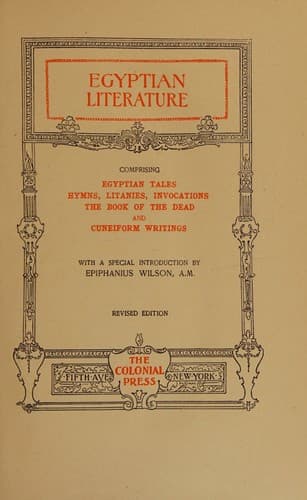
Egyptian Literature: Comprising Egyptian tales, hymns, litanies, invocations, the Book of the Dead, and cuneiform writings
Religion
Egyptian Literature: Comprising Egyptian tales, hymns, litanies, invocations, the Book of the Dead, and cuneiform writings
Egyptian literature -- Translations into English
O blessed Rā-Harmachis thou penetratest ... Bull at night,
Chieftain by day, beauteous orb of _mafek_, King of heaven, Sovran
of earth, great image in the horizon of heaven. Rā who hast made
beings, Tatanen giving life to mankind, Pharaoh son of Rā has
adored thee in thy glories, he has worshipped at thy gracious
rising brightness on the Eastern horizon, he makes tranquil thy
path, he beats down thy foes before thee in his turning back all
thy adversaries, he assigned to thee the _Uta_ on her seat, he
makes them ... he assigned to thee honors ... he cleared the way
for thee, he established thy rites in Abydos; he opens to thee
roads in Rusta, he beats down evil.
The Lamentations Of Isis And Nephthys
Translated by P. J. De Horrack
This papyrus was found by the late Mr. Passalaqua, in the ruins of Thebes,
in the interior of a statue representing Osiris. It is divided into two
parts, very distinct. The first contains chapters of the funeral ritual in
the hieroglyphic writing; the second, of which a translation here follows,
consists of five pages of a fine hieratic writing of the lower epoch
(probably about the time of the Ptolemies).
This manuscript now belongs to the Royal Museum of Berlin, where it is
registered under the No. 1425.
A partial translation of it was published in 1852 by M. H. Brugsch (“_Die
Adonisklage und das Linoslied_”). He translated the second page and the
beginning of the third, but without giving the hieratic text. I have since
published and completely translated this interesting document (“_Les
Lamentations d’Isis et de Nephthys_,” Paris, 1866), and now give the
English translation revised.
The composition has a great analogy with the “Book of Respirations,” a
translation of which will be added here. Both refer to the resurrection
and renewed birth of Osiris (the type of man after his death), who, in
this quality, is identified with the sun, the diurnal renewal of which
constantly recalled the idea of a birth eternally renewed. The object of
the prayers recited by Isis and Nephthys is to effect the resurrection of
their brother Osiris, and also that of the defunct to whom the papyrus is
consecrated.
LAMENTATIONS OF ISIS AND NEPHTHYS
Public-domain text, read in full here on John Shaqi.
Reviews
Reviews
No reviews yet
Be the first to share your thoughts on this work.
Elsewhere in the archive
Join the Discussion
Join the discussion
Sign in to leave a comment or review.
Sign InorCreate an account