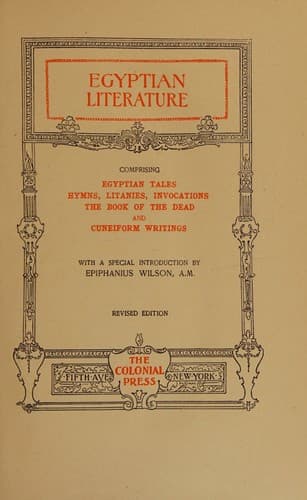
Egyptian Literature: Comprising Egyptian tales, hymns, litanies, invocations, the Book of the Dead, and cuneiform writings
Religion
Egyptian Literature: Comprising Egyptian tales, hymns, litanies, invocations, the Book of the Dead, and cuneiform writings
Egyptian literature -- Translations into English
Recital of the beneficial formulæ
made by the two divine Sisters(570)
in the house of Osiris who resides in the West,
Great god, Lord of Abydos,
in the month of Choiak, the twenty-fifth day.
They are made the same in all the abodes of Osiris,
and in all his festivals;
and they are beneficial to his soul,
giving firmness to his body,
diffusing joy through his being,
giving breath to the nostrils, to the dryness of the throat;
they satisfy the heart of Isis as well as (that) of Nephthys;
they place Horus on the throne of his father,
(and) give life, stability, tranquillity to Osiris-Tentrut(571)
born of Takha-aa, who is surnamed Persais the justified.
It is profitable to recite them,
in conformity with the divine words.
Evocation By Isis.(572) (She says:)
Come to thine abode, come to thine abode!
God An,(573) come to thine abode!
Thine enemies (exist) no more.
O excellent Sovereign, come to thine abode!
Look at me; I am thy sister who loveth thee.
Do not stay far from me, O beautiful youth.
Come to thine abode _with haste, with haste_.
I see thee no more.
My heart is full of bitterness on account of thee.
Mine eyes seek thee;
I seek thee to behold thee.
will it be long ere I see thee?
Will it be long ere I see thee?
(O) excellent Sovereign,
will it be long ere I see thee?
Beholding thee is happiness;
Beholding thee is happiness.
(O) god An, beholding thee is happiness.
Come to her who loveth thee.
(O) Un-nefer,(574) the justified.
Come to thy sister, come to thy wife.
(O) Urt-het,(575) come to thy spouse.
I am thy sister by thy mother;
do not separate thyself from me.
Gods and men (turn) their faces toward thee,
weeping together for thee, whenever (they) behold me.
I call thee in (my) lamentations
(even) to the heights of Heaven,
and thou hearest not my voice.
I am thy sister who loveth thee on earth;
no one else hath loved thee more than I,
(thy) sister, (thy) sister.
Evocation By Nephthys. (She says:)
Public-domain text, read in full here on John Shaqi.
Reviews
Reviews
No reviews yet
Be the first to share your thoughts on this work.
Elsewhere in the archive
Join the Discussion
Join the discussion
Sign in to leave a comment or review.
Sign InorCreate an account