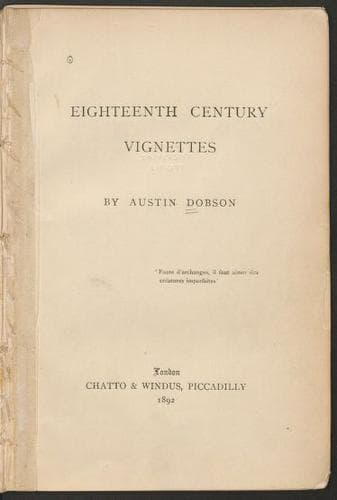
English literature -- 18th century -- History and criticism; Great Britain -- Intellectual life -- 18th century
home of Hiss Linwood's Art Needlework, which belongs to the present
century, this paper has nothing to do.
Moreover, we are straying from Leicester House itself. Deserted of
royalty, it passed into the hands of Mr., afterwards Sir Ashton Lever
(grand uncle of Charles Lever the novelist), who transferred to it
in 1771 the miscellaneous collection he had christened the
'Holophusikon'--a name which did not escape the gibes of the
professional jester. His _omnium gatherum_ of natural objects and savage
costumes was, nevertheless, a remarkable one, still more remarkable when
regarded as the work of a single man. It filled sixteen of the rooms at
Leicester House, besides overflowing on the staircases, and included,
not only all the curiosities Cook had brought home from his voyages,
but also a valuable assortment of bows and arrows of all countries
contributed by Mr. Richard Owen Cambridge of Twickenham. *
* See 'Cambridge the Everything,' in 'Eighteenth Century
Vignettes,' 3rd series, 1896, p. 1847 In an outhouse of the
'Holophusikon,' it may be added, were exhibited (stuffed)
Queen Charlotte's elephant and female zebra--two favourites
of royalty, which, during their lifetime, had enjoyed an
exceptional, if not always enviable, notoriety.
Its possessor had been persuaded that his treasures which, in their
first home at Alkrington near Manchester, had enjoyed great popularity,
would be equally successful in London. The result, however, did not
justify the expectation (an admittance of 5s. 3d.. per person must
have been practically prohibitive), and poor Sir Ashton was ultimately
'obligated,' as Tony Lumpkin would say, to apply to Parliament for power
to dispose of his show, as a whole, by lottery. He estimated his outlay
at £50,000. Of 30,000 tickets issued at a guinea each, only 8,000 were
taken up. The lottery was drawn in March, 1780, and the winner was a Mr.
Parkinson, who transferred his prize to the Rotunda at the Southern
or Surrey end of Blackfriars Bridge, changing its name to the Museum
Leverianum. But it was foredoomed to misfortune, and in 1800 was
dispersed under the hammer. A few years after it had crossed the river,
Leicester House in turn disappeared, being pulled down in 1790. *
* A house in Lisle Street, looking down Leicester Place,
still (1897) perpetuates the name, and bears on its façade
in addition the words, 'New Lisle Street, mdccxci.' It is
occupied by a foreign school or schools ('Ecoles de Notre
Dame de France').
In 1791 Lisle Street was continued across its garden; and a little later
still, Leicester Place traversed its site, running parallel to Leicester
Street, which had existed long previously, being described in 1720
'as ordinarily built and inhabited, except the west side, towards the
Fields, where there is a very good house.'
Public-domain text, read in full here on John Shaqi.
Reviews
Reviews
No reviews yet
Be the first to share your thoughts on this work.
Elsewhere in the archive
Join the Discussion
Join the discussion
Sign in to leave a comment or review.
Sign InorCreate an account