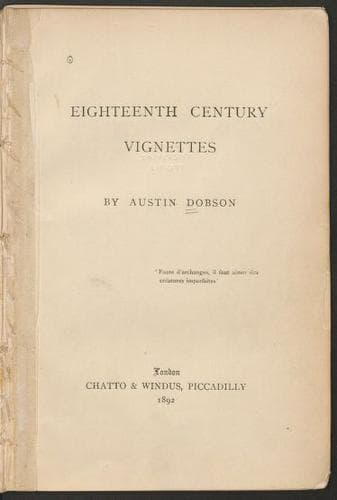
English literature -- 18th century -- History and criticism; Great Britain -- Intellectual life -- 18th century
In March, 1751, an end came to these lighthearted junketings, when His
Royal Highness quitted the scene almost precipitately from the breaking
of an abscess in his side, caused by the blow of a cricket-ball at
Cliveden. The Princess and her children continued to live in Leicester
Fields until 1766. Meanwhile, to the accompaniment of trumpets and
kettledrums, the old house witnessed the proclamation of George III.,
and the marriage, in its great drawing-room, of the Princess Augusta
to Ferdinand, Hereditary Prinee of Brunswick, one of the most popular
heroes ever huzzaed to by an English mob. After this last occurrence,
the only important event connected with royalty in the Fields is the
death at Savile House on 29th December, 1765, of one of the princes.
'The King's youngest brother, Prince Frederick,' writes Walpole (with
one of those Gallic affectations of phrase which roused the anger of
Macaulay) 'is dead, of a dropsy and consumption: he was a pretty and
promising boy.'
The Savile House above referred to stood next to Leicester House on the
west. Savile House, too, was not without its memories. It was here
that Peter the Great had boozed with his pot companion, the Marquis of
Caermarthen, who occupied it when the Czar made his famous visit to this
country in 1698. More than one English home bore dirty testimony to the
passage of the imperial savage and his suite, the decorous dwelling of
John Evelyn in particular, at Sayes Court, Deptford, being made 'right
nasty.' There is, however, no special record of any wrong to
Savile House beyond the spilling, down the autocratic throat, of an
'intolerable deal of sack' and peppered brandy. In January, 1718,
the house was taken by the Prince of Wales, and when, a little later,
Leicester House was vacated by Lord Gower, a communication was opened
between the two, the smaller being devoted to the royal children. It
belonged originally to Aylesbury family, and came through them to the
Saviles, one of whom was the Sir George Savile who is by some supposed
to have sat for Goldsmith's Mr. Burchell. Sir George was its tenant
in the riots of '80, when (as Dickens has not failed to remember in
'Barnaby Rudge') it was besieged by the rioters because he had brought
in the Catholic Bill. 'Between Twelve and One O'clock Yesterday morning
[June 6th]--says the 'Public Advertiser'--'a large Body [of rioters]
assembled before Sir George Savile's House in Leicester Fields, and
after breaking all the Windows, destroyed some of the Furniture.' They
were finally dispersed by a party of the Horse Grenadier Guards, but not
before they had torn up all the iron railings in front of the building,
which they afterwards used effectively as weapons of offence. Burke,
who had also supported the Bill, was only saved from a like fate by
the exertions of sixteen soldiers who garrisoned his house in Charles
Street, St. James's Square. With the later use of Savile House, as the
Public-domain text, read in full here on John Shaqi.
Reviews
Reviews
No reviews yet
Be the first to share your thoughts on this work.
Elsewhere in the archive
Join the Discussion
Join the discussion
Sign in to leave a comment or review.
Sign InorCreate an account