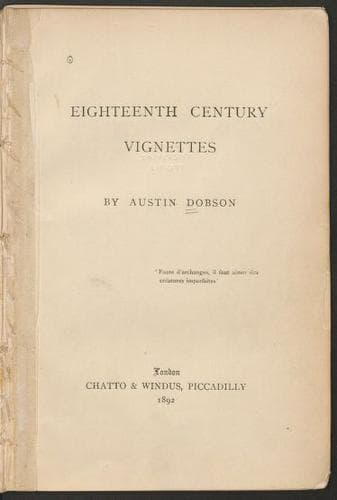
English literature -- 18th century -- History and criticism; Great Britain -- Intellectual life -- 18th century
* A so-ealled Observatory on the roof, now non-existent, was
for many years exhibited at Newton's. Recent authorities,
however, contend that this was the fabrication of a later
tenant. But it should be noted that Madame D'Arblay, who
also lived in the house, and wrote novels in the room in
question, seems to have had no doubts of the kind. She says
('Memoirs of Dr. Burney,' 1832, i. 290-1) that her father
not only reverently repaired the Observatory when he entered
upon his tenancy of No. 35 [in 1774], but went to the
expense of practically reconstructing it when it was all but
destroyed by the hurricane of 1778.
But there was one member of his household, a few years later, who must
certainly have added to the attractions of the ordinary two-storeyed
building where he superintended the revision of the second and third
editions of the 'Prineipia.' This was his kinswoman,--the 'jolie
niece' of Voltaire,--the 'famous witty Miss Barton' of the 'Gentleman's
Magazine.' At this date she was 'Superintendant of his domestick
Affairs' to Charles, Earl of Halifax, who, dying in 1715, left her
£5,000 and a house, 'as a Token'--so runs the bequest--'of the sincere
Love, Affection, and Esteem I have long had for her Person, and as
a small Recompence for the Pleasure and Happiness I have had in her
Conversation.' This, taken in connection with the fact that, since 1706,
she had been in receipt of an annuity of £200 a year, purchased in
her uncle's name, but for which Halifax was trustee, has led to the
conclusion that the relation between the pair was something closer than
friendship, and that, following other contemporary precedents, they
were privately married. * Be this as it may, Catherine Barton is also
interesting as one of the group of gifted women to whom Swift extended
the privilege of that half-patronising, half-playful, and wholly
unconventional intimacy which is at once the attraction and the enigma
of his relations with the other sex.
* See 'Newton: his Friend: and his Niece,' 1885, by
Professor Augustus de Morgan, which labours, with much
digression, but with infinite ingenuity and erudition, to
establish this satisfactory solution of a problem in which
the good fame of Newton cannot be regarded as entirely
unconcerned.
He met her often in London, though not as often as he wished. 'I love
her better than any-one here,' he tells Stella in April, 1711, 'and see
her seldomer.' He dines with her 'alone at her lodgings'; he goes
with her to other houses; and, Tory though he has become, endures her
vivacious Whiggery.
Public-domain text, read in full here on John Shaqi.
Reviews
Reviews
No reviews yet
Be the first to share your thoughts on this work.
Elsewhere in the archive
Join the Discussion
Join the discussion
Sign in to leave a comment or review.
Sign InorCreate an account