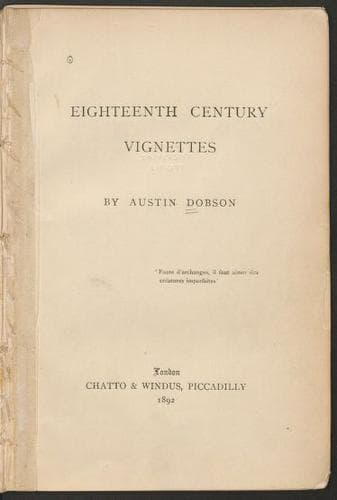
English literature -- 18th century -- History and criticism; Great Britain -- Intellectual life -- 18th century
When, at Halifax's death, Catherine Barton, in all probability, returned
to her uncle's house, Swift had already gone back to Ireland, and there
is no reason for supposing that, although he had lodgings 'in Leicester
Fields' in 1711, he ever visited his friend in St. Martin's Street.
In August, 1717, Mrs. Barton married John Conduitt, M.P., Xewton's
successor as Master of the Mint, and when in town continued to reside
with her husband under Newton's roof. And though Halifax was dead, and
Swift in exile, and Prior 'in the messenger's hand,' there can be little
doubt that during her brief widowhood (?) and second wifehood, those
friends who had clustered about the former toast of the Kit Cats must
still have continued to visit her. The chairs of Lady Worsley and Lady
Betty Germaine must often have waited in the narrow entrance to St.
Martin's Street, while the ladies 'disputed Whig and Tory' with Mrs.
Conduitt, or were interrupted in their _tête-à-tête_ by Gay and his
Duchess. After Sir Isaac--a long while after--the most notable tenant of
the old house was Dr. Charles Burney, author of the 'History of Music,'
and of Fanny Burney. Indeed, it was in this very building--with the
unassuming little chapel on its right where 'Rainy Day' Smith had often
heard Toplady preach--that a mere girl in her teens--no, ungallant
Mr. Croker discovered her to have been actually a young woman of
five-and-twenty--wrote that 'Evelina' which, in 1778, took the Town
by storm. There were panelled rooms and a painted ceiling in the
Newton-Burney house of yore, but it could scarcely be here that the
little person whom in her graver moments Mrs. Piozzi nicknamed the 'Lady
Louisa of Leicester Square' danced round an unmetaphoric mulberry tree
with delight at her success in letters, for there are no traces of a
garden. At present, in this quiet backwater of street traffic, where
Burke and Johnson and Franklin and Reynolds all came formerly to visit
their favourite authoress, nothing is discoverable but a dingy tenement
with dusty upper windows, with a ground floor that is used as a day
school, and a front of stucco'd red brick upon which the blue tablet of
the Society of Arts has something of the forlorn effect of an order of
merit upon a shoeblack.
Public-domain text, read in full here on John Shaqi.
Reviews
Reviews
No reviews yet
Be the first to share your thoughts on this work.
Elsewhere in the archive
Join the Discussion
Join the discussion
Sign in to leave a comment or review.
Sign InorCreate an account