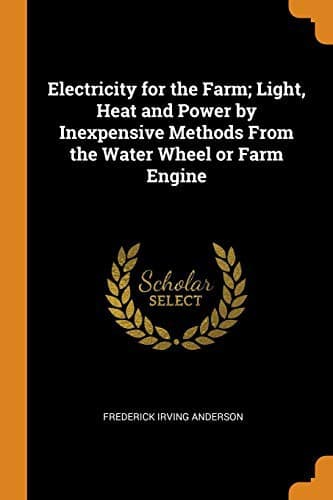
Electricity for the farm: Light, heat and power by inexpensive methods from the water wheel or farm engineAnderson, Frederick Irving
Science
Electricity for the farm: Light, heat and power by inexpensive methods from the water wheel or farm engine
Anderson, Frederick Irving
Electricity in agriculture
There are several answers to this question, which will be taken up in
detail in subsequent chapters. Here, let us say, even if this brook
does flow in sufficient volume only 8 months in a year--the dark
months, by the way,--is not electricity and the many benefits it
provides worth having eight months in the year? My garden provides
fresh vegetables four months a year. Because it withers and dies and
lies covered with snow during the winter, is that any reason why I
should not plow and manure and plant my garden when spring comes
again?
A water wheel, the modern turbine, is a circular fan with curved iron
blades, revolving in an iron case. Water, forced through the blades of
this fan by its own weight, causes the wheel to revolve on its axis;
and the fan, in turn causes a shaft fitted with pulleys to revolve.
The water, by giving the iron-bladed fan a turning movement as it
rushes through, imparts to it mechanical power. The shaft set in
motion by means of this mechanical power is, in turn, belted to the
pulley of a dynamo. This dynamo consists, first, of a shaft on which
is placed a spool, wound in a curious way, with many turns of
insulated copper wire. This spool revolves freely in an air space
surrounded by electric magnets. The spool does not touch these
magnets. It is so nicely balanced that the weight of a finger will
turn it. Yet, when it is revolved by water-power at a predetermined
speed--say 1,500 revolutions a minute--it generates electricity,
transforms the mechanical power of the water wheel into another form
of energy--a form of energy which can be carried for long distances on
copper wires, which can, by touching a button, be itself converted
into light, or heat, or back into mechanical energy again.
If two wires be led from opposite sides of this revolving spool, and
an electric lamp be connected from one to the other wire, the lamp
will be lighted--will grow white hot,--hence _incandescent light_.
The instant this lamp is turned on, the revolving spool feels a
stress, the magnets by which it is surrounded begin to pull back on
it. The power of the water wheel, however, overcomes this pull. If one
hundred lights be turned on, the backward pull of the magnets
surrounding the spool will be one hundred times as strong as for one
light. For every ounce of electrical energy used in light or heat or
power, the dynamo will require a like ounce of mechanical power from
the water wheel which drives it.
The story is told of a canny Scotch engineer, who, in the first days
of dynamos, not so very long ago, scoffed at the suggestion that such
a spool, spinning in free air, in well lubricated bearings, could
bring his big Corliss steam engine to a stop. Yet he saw it done
simply by belting this "spool," a dynamo, to his engine and asking the
dynamo for more power in terms of light than his steam could deliver
in terms of mechanical power to overcome the pull of the magnets.
Public-domain text, read in full here on John Shaqi.
Reviews
Reviews
No reviews yet
Be the first to share your thoughts on this work.
Join the Discussion
Join the discussion
Sign in to leave a comment or review.
Sign InorCreate an account