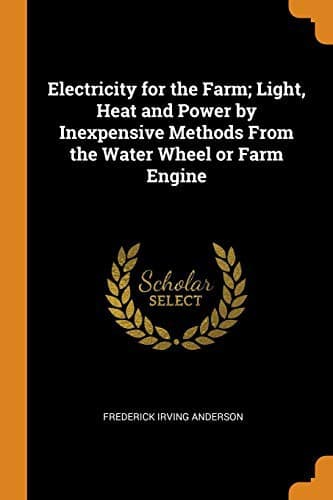
Electricity for the farm: Light, heat and power by inexpensive methods from the water wheel or farm engineAnderson, Frederick Irving
Science
Electricity for the farm: Light, heat and power by inexpensive methods from the water wheel or farm engine
Anderson, Frederick Irving
Electricity in agriculture
"Water is the common and equal property of every one through whose
land it flows, and the right of each land-owner to use and consume it
without destroying, or unreasonably impairing the rights of others, is
the same. An owner of land bordering on a running stream has the right
to have its waters flow naturally, and none can lawfully divert them
without his consent. Each riparian proprietor has an equal right with
all the others to have the stream flow in its natural way without
substantial reduction in volume, or deterioration in quality, subject
to a proper and reasonable use of its waters for domestic,
agricultural and manufacturing purposes, and he is entitled to use it
himself for such purposes, but in doing so must not substantially
injure others. In addition to the right of drawing water for the
purposes just mentioned, a riparian proprietor, if he duly regards the
rights of others, and does not unreasonably deplete the supply, has
also the right to take the water for some other proper uses."
Thus, the farmer who seeks to develop water-power from a stream
flowing across his own land, has the right to divert such a stream
from its natural channel--providing it is not a navigable or floatable
stream--but in so doing, he must return it to its own channel for
lower riparian owners. The generation of water-power does not pollute
the water, nor does it diminish the water in quantity, therefore the
farmer is infringing on no other owner's rights in using the water for
such a purpose.
When a stream is a dividing line between two farms, as is frequently
the case, each proprietor owns to the middle of the stream and
controls its banks. Therefore to erect a dam across such a private
stream and divert all or a part of the water for power purposes,
requires the consent of the neighboring owner. The owner of the dam is
responsible for damage due to flooding, to upstream riparian owners.
PART II
ELECTRICITY
CHAPTER V
THE DYNAMO; WHAT IT DOES, AND HOW
Electricity compared to the heat and light of the Sun--The simple
dynamo--The amount of electric energy a dynamo will generate--The
modern dynamo--Measuring power in terms of electricity--The
volt--The ampere--The ohm--The watt and the kilowatt--Ohm's Law of
the electric circuit, and some examples of its application--Direct
current, and alternating current--Three types of direct-current
dynamos: series, shunt, and compound.
What a farmer really does in generating electricity from water that
would otherwise run to waste in his brook, is to install a private Sun
of his own--which is on duty not merely in daylight, but twenty-four
hours a day; a private Sun which is under such simple control that it
shines or provides heat and power, when and where wanted, simply by
touching a button.
Public-domain text, read in full here on John Shaqi.
Reviews
Reviews
No reviews yet
Be the first to share your thoughts on this work.
Join the Discussion
Join the discussion
Sign in to leave a comment or review.
Sign InorCreate an account