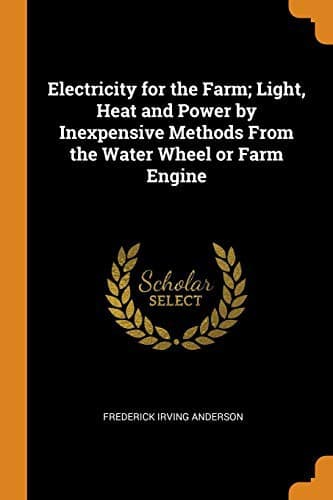
Electricity for the farm: Light, heat and power by inexpensive methods from the water wheel or farm engineAnderson, Frederick Irving
Science
Electricity for the farm: Light, heat and power by inexpensive methods from the water wheel or farm engine
Anderson, Frederick Irving
Electricity in agriculture
Let us illustrate its application by an example. The water wheel is
started and is spinning the dynamo at its rated speed, say 1,500
r.p.m. Two heavy wires, leading from brushes which collect electricity
from the revolving armature, are led, by suitable insulated supports
to the switchboard, and fastened there. They do not touch each other.
Dynamo mains must not be permitted to touch each other _under any
conditions_. They are separated by say four inches of air. Dry air is
a very poor conductor of electricity. Let us say, for the example,
that dry air has a resistance to the flow of an electric current, of
1,000,000 ohms to the inch--that would be 4,000,000 ohms. How much
electricity is being permitted to escape from the armature of this
110-volt dynamo, when the mains are separated by four inches of dry
air? Apply Ohm's law, C equals E divided by R. E, in this case is 110;
R is 4,000,000; therefore C (amperes) equals 110/4,000,000--an
infinitesimal amount--about .0000277 ampere.
Let us say that instead of separating these two mains by air we
separated them by the human body--that a man took hold of the bare
wires, one in each hand. The resistance of the human body varies from
5,000 to 10,000 ohms. In that case C (amperes) equals 110/5,000, or
110/10,000--about 1/50th, or 1/100th of an ampere. This illustrates
why an electric current of 110 volts pressure is not fatal to human
beings, under ordinary circumstances. The body offers too much
resistance. But, if the volts were 1,100 instead of the usual 110 used
in commercial and private plants for domestic use, the value of C, by
this formula at 5,000 ohms, would be nearly 1/5th ampere. To drive
1/5th ampere of electricity through the human body would be fatal in
many instances. The higher the voltage, the more dangerous the
current. In large water-power installations in the Far West, where the
current must be transmitted over long distances to the spot where it
is to be used, it is occasionally generated at a pressure of 150,000
volts. Needless to say, contact with such wires means instant death.
Before being used for commercial or domestic purposes, in such cases,
the voltage is "stepped down" to safe pressures--to 110, or to 220, or
to 550 volts--always depending on the use made of it.
Public-domain text, read in full here on John Shaqi.
Reviews
Reviews
No reviews yet
Be the first to share your thoughts on this work.
Join the Discussion
Join the discussion
Sign in to leave a comment or review.
Sign InorCreate an account