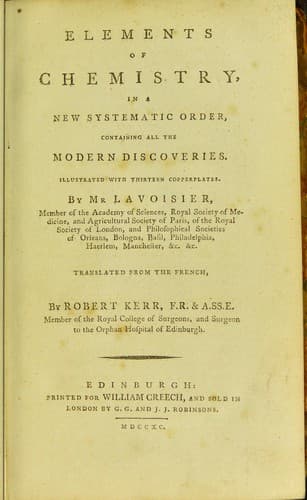
Elements of Chemistry,: In a New Systematic Order, Containing all the Modern DiscoveriesLavoisier, Antoine Laurent
Science
Elements of Chemistry,: In a New Systematic Order, Containing all the Modern Discoveries
Lavoisier, Antoine Laurent
Chemistry -- Early works to 1800
From these phenomena it appears that oxygen is the bond of union between
metals and acids; and from this we are led to suppose that oxygen is
contained in all substances which have a strong affinity with acids:
Hence it is very probable the four eminently salifiable earths contain
oxygen, and their capability of uniting with acids is produced by the
intermediation of that element. What I have formerly noticed relative to
these earths is considerably strengthened by the above considerations,
viz. that they may very possibly be metallic oxyds, with which oxygen
has a stronger affinity than with charcoal, and consequently not
reducible by any known means.
All the acids hitherto known are enumerated in the following table, the
first column of which contains the names of the acids according to the
new nomenclature, and in the second column are placed the bases or
radicals of these acids, with observations.
_Names of the Acids._ _Names of the Bases, with Observations._
1. Sulphurous }Sulphur.
2. Sulphuric }
3. Phosphorous }Phosphorus.
4. Phosphoric }
5. Muriatic }Muriatic radical or base, hitherto unknown.
6. Oxygenated muriatic }
7. Nitrous }
8. Nitric }Azote.
9. Oxygenated nitric }
10. Carbonic Charcoal
}The bases or radicals of all these acids
11. Acetous }seem to be formed by a combination
12. Acetic }of charcoal and hydrogen;
13. Oxalic }and the only difference seems to be
14. Tartarous }owing to the different proportions in
15. Pyro-tartarous }which these elements combine to form
16. Citric }their bases, and to the different doses
17. Malic }of oxygen in their acidification. A
18. Pyro-lignous }connected series of accurate experiments
19. Pyro-mucous }is still wanted upon this subject.
20. Gallic }Our knowledge of the bases of
21. Prussic }these acids is hitherto imperfect; we
22. Benzoic }only know that they contain hydrogen
23. Succinic }and charcoal as principal elements,
24. Camphoric }and that the prussic acid contains
25. Lactic }azote.
26. Saccholactic }
27. Bombic }The base of these and all acids
28. Formic }procured from animal substances seems
29. Sebacic }to consist of charcoal, hydrogen,
}phosphorous, and azote.
30. Boracic }The bases of these two are hitherto
31. Fluoric }entirely unknown.
Public-domain text, read in full here on John Shaqi.
Reviews
Reviews
No reviews yet
Be the first to share your thoughts on this work.
Elsewhere in the archive
Join the Discussion
Join the discussion
Sign in to leave a comment or review.
Sign InorCreate an account