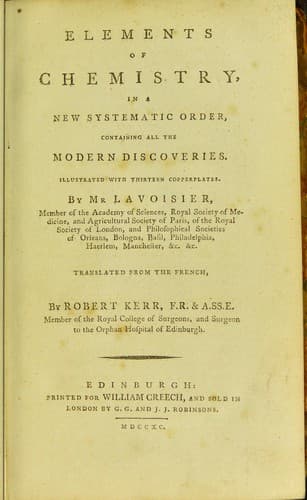
Elements of Chemistry,: In a New Systematic Order, Containing all the Modern DiscoveriesLavoisier, Antoine Laurent
Science
Elements of Chemistry,: In a New Systematic Order, Containing all the Modern Discoveries
Lavoisier, Antoine Laurent
Chemistry -- Early works to 1800
The first and most striking of these is the effervescence, or, to speak
less equivocally, the disengagement of gas which takes place during the
solution; in the solutions made in nitric acid this effervescence is
produced by the disengagement of nitrous gas; in solutions with
sulphuric acid it is either sulphurous acid gas or hydrogen gas,
according as the oxydation of the metal happens to be made at the
expence of the sulphuric acid or of the water. As both nitric acid and
water are composed of elements which, when separate, can only exist in
the gasseous form, at least in the common temperature of the atmosphere,
it is evident that, whenever either of these is deprived of its oxygen,
the remaining element must instantly expand and assume the state of gas;
the effervescence is occasioned by this sudden conversion from the
liquid to the gasseous state. The same decomposition, and consequent
formation of gas, takes place when solutions of metals are made in
sulphuric acid: In general, especially by the humid way, metals do not
attract all the oxygen it contains; they therefore reduce it, not into
sulphur, but into sulphurous acid, and as this acid can only exist as
gas in the usual temperature, it is disengaged, and occasions
effervescence.
The second phenomenon is, that, when the metals have been previously
oxydated, they all dissolve in acids without effervescence: This is
easily explained; because, not having now any occasion for combining
with oxygen, they neither decompose the acid nor the water by which, in
the former case, the effervescence is occasioned.
A third phenomenon, which requires particular consideration, is, that
none of the metals produce effervescence by solution in oxygenated
muriatic acid. During this process the metal, in the first place,
carries off the excess of oxygen from the oxygenated muriatic acid, by
which it becomes oxydated, and reduces the acid to the state of ordinary
muriatic acid. In this case there is no production of gas, not that the
muriatic acid does not tend to exist in the gasseous state in the common
temperature, which it does equally with the acids formerly mentioned,
but because this acid, which otherwise would expand into gas, finds more
water combined with the oxygenated muriatic acid than is necessary to
retain it in the liquid form; hence it does not disengage like the
sulphurous acid, but remains, and quietly dissolves and combines with
the metallic oxyd previously formed from its superabundant oxygen.
The fourth phenomenon is, that metals are absolutely insoluble in such
acids as have their bases joined to oxygen by a stronger affinity than
these metals are capable of exerting upon that acidifying principle.
Hence silver, mercury, and lead, in their metallic states, are insoluble
in muriatic acid, but, when previously oxydated, they become readily
soluble without effervescence.
Public-domain text, read in full here on John Shaqi.
Reviews
Reviews
No reviews yet
Be the first to share your thoughts on this work.
Elsewhere in the archive
Join the Discussion
Join the discussion
Sign in to leave a comment or review.
Sign InorCreate an account