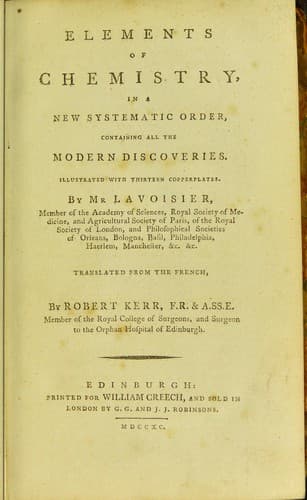
Elements of Chemistry,: In a New Systematic Order, Containing all the Modern DiscoveriesLavoisier, Antoine Laurent
Science
Elements of Chemistry,: In a New Systematic Order, Containing all the Modern Discoveries
Lavoisier, Antoine Laurent
Chemistry -- Early works to 1800
Thus, as chemistry advances towards perfection, by dividing and
subdividing, it is impossible to say where it is to end; and these
things we at present suppose simple may soon be found quite otherwise.
All we dare venture to affirm of any substance is, that it must be
considered as simple in the present state of our knowledge, and so far
as chemical analysis has hitherto been able to show. We may even presume
that the earths must soon cease to be considered as simple bodies; they
are the only bodies of the salifiable class which have no tendency to
unite with oxygen; and I am much inclined to believe that this proceeds
from their being already saturated with that element. If so, they will
fall to be considered as compounds consisting of simple substances,
perhaps metallic, oxydated to a certain degree. This is only hazarded as
a conjecture; and I trust the reader will take care not to confound what
I have related as truths, fixed on the firm basis of observation and
experiment, with mere hypothetical conjectures.
The fixed alkalies, potash, and soda, are omitted in the foregoing
Table, because they are evidently compound substances, though we are
ignorant as yet what are the elements they are composed of.
TABLE _of compound oxydable and acidifiable bases._
_Names of the radicals._
Oxydable or acidifiable { Nitro-muriatic radical or
base, from the mineral { base of the acid formerly
kingdom. { called aqua regia.
{ Tartarous radical or base.
{ Malic. }
{ Citric. }
{ Pyro-lignous. }
Oxydable or acidifiable { Pyro-mucous. }
hydro-carbonous or { Pyro-tartarous. }
carbono-hydrous radicals { Oxalic. }
from the vegetable { Acetous. }
kingdom. { Succinic. } Radicals
{ Benzoic. }
{ Camphoric. }
{ Gallic. }
}
Oxydable or acidifiable { Lactic. }
radicals from the animal { Saccholactic. }
kingdom, which { Formic. }
mostly contain azote, { Bombic. }
and frequently phosphorus. { Sebacic. }
{ Lithic. }
{ Prussic. }
_Note._--The radicals from the vegetable kingdom are converted by a
first degree of oxygenation into vegetable oxyds, such as sugar, starch,
and gum or mucus: Those of the animal kingdom by the same means form
animal oxyds, as lymph, &c.--A.
SECT. II.--_Observations upon the Table of Compound Radicals._
Public-domain text, read in full here on John Shaqi.
Reviews
Reviews
No reviews yet
Be the first to share your thoughts on this work.
Elsewhere in the archive
Join the Discussion
Join the discussion
Sign in to leave a comment or review.
Sign InorCreate an account