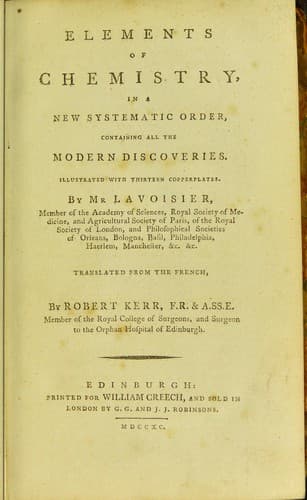
Elements of Chemistry,: In a New Systematic Order, Containing all the Modern DiscoveriesLavoisier, Antoine Laurent
Science
Elements of Chemistry,: In a New Systematic Order, Containing all the Modern Discoveries
Lavoisier, Antoine Laurent
Chemistry -- Early works to 1800
The older chemists being unacquainted with the composition of acids, and
not suspecting them to be formed by a peculiar radical or base for each,
united to an acidifying principle or element common to all, could not
consequently give any name to substances of which they had not the most
distant idea. We had therefore to invent a new nomenclature for this
subject, though we were at the same time sensible that this nomenclature
must be susceptible of great modification when the nature of the
compound radicals shall be better understood[37].
The compound oxydable and acidifiable radicals from the vegetable and
animal kingdoms, enumerated in the foregoing table, are not hitherto
reducible to systematic nomenclature, because their exact analysis is as
yet unknown. We only know in general, by some experiments of my own, and
some made by Mr Hassenfratz, that most of the vegetable acids, such as
the tartarous, oxalic, citric, malic, acetous, pyro-tartarous, and
pyromucous, have radicals composed of hydrogen and charcoal, combined
in such a way as to form single bases, and that these acids only differ
from each other by the proportions in which these two substances enter
into the composition of their bases, and by the degree of oxygenation
which these bases have received. We know farther, chiefly from the
experiments of Mr Berthollet, that the radicals from the animal kingdom,
and even some of those from vegetables, are of a more compound nature,
and, besides hydrogen and charcoal, that they often contain azote, and
sometimes phosphorus; but we are not hitherto possessed of sufficiently
accurate experiments for calculating the proportions of these several
substances. We are therefore forced, in the manner of the older
chemists, still to name these acids after the substances from which they
are procured. There can be little doubt that these names will be laid
aside when our knowledge of these substances becomes more accurate and
extensive; the terms _hydro-carbonous_, _hydro-carbonic_,
_carbono-hydrous_, and _carbono hydric_[38], will then become
substituted for those we now employ, which will then only remain as
testimonies of the imperfect state in which this part of chemistry was
transmitted to us by our predecessors.
It is evident that the oils, being composed of hydrogen and charcoal
combined, are true carbono-hydrous or hydro-carbonous radicals; and,
indeed, by adding oxygen, they are convertible into vegetable oxyds and
acids, according to their degrees of oxygenation. We cannot, however,
affirm that oils enter in their entire state into the composition of
vegetable oxyds and acids; it is possible that they previously lose a
part either of their hydrogen or charcoal, and that the remaining
ingredients no longer exist in the proportions necessary to constitute
oils. We still require farther experiments to elucidate these points.
Public-domain text, read in full here on John Shaqi.
Reviews
Reviews
No reviews yet
Be the first to share your thoughts on this work.
Elsewhere in the archive
Join the Discussion
Join the discussion
Sign in to leave a comment or review.
Sign InorCreate an account