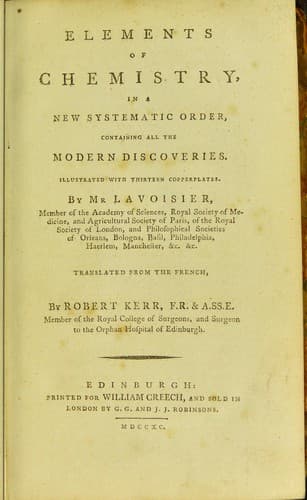
Elements of Chemistry,: In a New Systematic Order, Containing all the Modern DiscoveriesLavoisier, Antoine Laurent
Science
Elements of Chemistry,: In a New Systematic Order, Containing all the Modern Discoveries
Lavoisier, Antoine Laurent
Chemistry -- Early works to 1800
From these observations, it appears that the vegetable and animal oxyds
and acids may differ from each other in three several ways: 1st,
According to the number of simple acidifiable elements of which their
radicals are composed: 2dly, According to the proportions in which these
are combined together: And, 3dly, According to their different degrees
of oxygenation: Which circumstances are more than sufficient to explain
the great variety which nature produces in these substances. It is not
at all surprising, after this, that most of the vegetable acids are
convertible into each other, nothing more being requisite than to change
the proportions of the hydrogen and charcoal in their composition, and
to oxygenate them in a greater or lesser degree. This has been done by
Mr Crell in some very ingenious experiments, which have been verified
and extended by Mr Hassenfratz. From these it appears, that charcoal and
hydrogen, by a first oxygenation, produce tartarous acid, oxalic acid by
a second degree, and acetous or acetic acid by a third, or higher
oxygenation; only, that charcoal seems to exist in a rather smaller
proportion in the acetous and acetic acids. The citric and malic acids
differ little from the preceding acids.
Ought we then to conclude that the oils are the radicals of the
vegetable and animal acids? I have already expressed my doubts upon
this subject: 1st, Although the oils appear to be formed of nothing but
hydrogen and charcoal, we do not know if these are in the precise
proportion necessary for constituting the radicals of the acids: 2dly,
Since oxygen enters into the composition of these acids equally with
hydrogen and charcoal, there is no more reason for supposing them to be
composed of oil rather than of water or of carbonic acid. It is true
that they contain the materials necessary for all these combinations,
but then these do not take place in the common temperature of the
atmosphere; all the three elements remain combined in a state of
equilibrium, which is readily destroyed by a temperature only a little
above that of boiling water[39].
TABLE _of the Binary Combinations of Azote with the Simple Substances._
_Simple Substances._ _Results of the Combinations._
_New Nomenclature._ _Old Nomenclature._
Caloric Azotic gas Phlogisticated air, or Mephitis.
Hydrogen Ammoniac Volatile alkali.
{Nitrous oxyd Base of Nitrous gas.
{Nitrous acid Smoaking nitrous acid.
Oxygen {Nitric acid Pale nitrous acid.
{Oxygenated nitric acid Unknown.
Public-domain text, read in full here on John Shaqi.
Reviews
Reviews
No reviews yet
Be the first to share your thoughts on this work.
Elsewhere in the archive
Join the Discussion
Join the discussion
Sign in to leave a comment or review.
Sign InorCreate an account