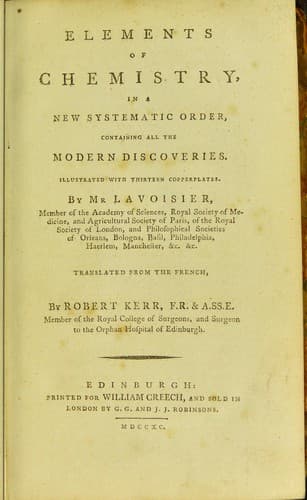
Elements of Chemistry,: In a New Systematic Order, Containing all the Modern DiscoveriesLavoisier, Antoine Laurent
Science
Elements of Chemistry,: In a New Systematic Order, Containing all the Modern Discoveries
Lavoisier, Antoine Laurent
Chemistry -- Early works to 1800
{This combination is hitherto unknown; should it
{ever be discovered, it will be called, according to
Charcoal {the principles of our nomenclature, Azuret of
{Charcoal. Charcoal dissolves in azotic gas, and
{forms carbonated azotic gas.
Phosphorus. Azuret of phosphorus. Still unknown.
{Azuret of sulphur. Still unknown. We know
Sulphur {that sulphur dissolves in azotic gas, forming
{sulphurated azotic gas.
{Azote combines with charcoal and hydrogen, and
Compound {sometimes with phosphorus, in the compound
radicals {oxydable and acidifiable bases, and is generally
{contained in the radicals of the animal acids.
{Such combinations are hitherto unknown; if ever
Metallic {discovered, they will form metallic azurets, as
substances {azuret of gold, of silver, &c.
Lime {
Magnesia {
Barytes {Entirely unknown. If ever discovered, they will
Argill {form azuret of lime, azuret of magnesia, &c.
Potash {
Soda {
SECT. VI.--_Observations upon the Combinations of Azote with the Simple
Substances._
Azote is one of the most abundant elements; combined with caloric it
forms azotic gas, or mephitis, which composes nearly two thirds of the
atmosphere. This element is always in the state of gas in the ordinary
pressure and temperature, and no degree of compression or of cold has
been hitherto capable of reducing it either to a solid or liquid form.
This is likewise one of the essential constituent elements of animal
bodies, in which it is combined with charcoal and hydrogen, and
sometimes with phosphorus; these are united together by a certain
portion of oxygen, by which they are formed into oxyds or acids
according to the degree of oxygenation. Hence the animal substances may
be varied, in the same way with vegetables, in three different manners:
1st, According to the number of elements which enter into the
composition of the base or radical: 2dly, According to the proportions
of these elements: 3dly, According to the degree of oxygenation.
When combined with oxygen, azote forms the nitrous and nitric oxyds and
acids; when with hydrogen, ammoniac is produced. Its combinations with
the other simple elements are very little known; to these we give the
name of Azurets, preserving the termination in _uret_ for all
nonoxygenated compounds. It is extremely probable that all the alkaline
substances may hereafter be found to belong to this genus of azurets.
Public-domain text, read in full here on John Shaqi.
Reviews
Reviews
No reviews yet
Be the first to share your thoughts on this work.
Elsewhere in the archive
Join the Discussion
Join the discussion
Sign in to leave a comment or review.
Sign InorCreate an account