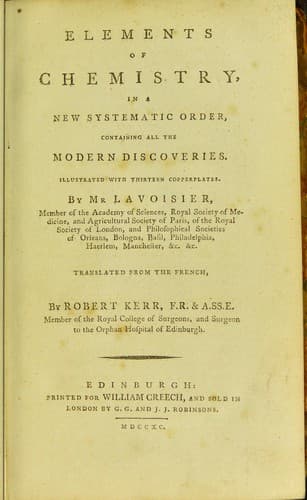
Elements of Chemistry,: In a New Systematic Order, Containing all the Modern DiscoveriesLavoisier, Antoine Laurent
Science
Elements of Chemistry,: In a New Systematic Order, Containing all the Modern Discoveries
Lavoisier, Antoine Laurent
Chemistry -- Early works to 1800
Hydrogen, as its name expresses, is one of the constituent elements of
water, of which it forms fifteen hundredth parts by weight, combined
with eighty-five hundredth parts of oxygen. This substance, the
properties and even existence of which was unknown till lately, is very
plentifully distributed in nature, and acts a very considerable part in
the processes of the animal and vegetable kingdoms. As it possesses so
great affinity with caloric as only to exist in the state of gas, it is
consequently impossible to procure it in the concrete or liquid state,
independent of combination.
To procure hydrogen, or rather hydrogen gas, we have only to subject
water to the action of a substance with which oxygen has greater
affinity than it has to hydrogen; by this means the hydrogen is set
free, and, by uniting with caloric, assumes the form of hydrogen gas.
Red hot iron is usually employed for this purpose: The iron, during the
process, becomes oxydated, and is changed into a substance resembling
the iron ore from the island of Elba. In this state of oxyd it is much
less attractible by the magnet, and dissolves in acids without
effervescence.
Charcoal, in a red heat, has the same power of decomposing water, by
attracting the oxygen from its combination with hydrogen. In this
process carbonic acid gas is formed, and mixes with the hydrogen gas,
but is easily separated by means of water or alkalies, which absorb the
carbonic acid, and leave the hydrogen gas pure. We may likewise obtain
hydrogen gas by dissolving iron or zinc in dilute sulphuric acid. These
two metals decompose water very slowly, and with great difficulty, when
alone, but do it with great ease and rapidity when assisted by sulphuric
acid; the hydrogen unites with caloric during the process, and is
disengaged in form of hydrogen gas, while the oxygen of the water unites
with the metal in the form of oxyd, which is immediately dissolved in
the acid, forming a sulphat of iron or of zinc.
Public-domain text, read in full here on John Shaqi.
Reviews
Reviews
No reviews yet
Be the first to share your thoughts on this work.
Elsewhere in the archive
Join the Discussion
Join the discussion
Sign in to leave a comment or review.
Sign InorCreate an account