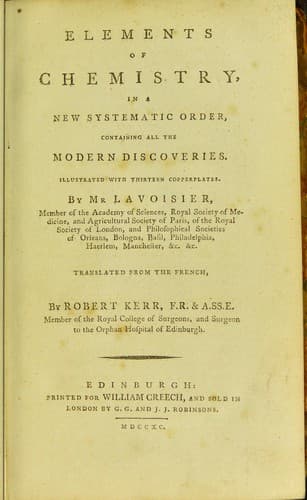
Elements of Chemistry,: In a New Systematic Order, Containing all the Modern DiscoveriesLavoisier, Antoine Laurent
Science
Elements of Chemistry,: In a New Systematic Order, Containing all the Modern Discoveries
Lavoisier, Antoine Laurent
Chemistry -- Early works to 1800
The azotic gas may be procured from atmospheric air, by absorbing the
oxygen gas which is mixed with it by means of a solution of sulphuret of
potash, or sulphuret of lime. It requires twelve or fifteen days to
complete this process, during which time the surface in contact must be
frequently renewed by agitation, and by breaking the pellicle which
forms on the top of the solution. It may likewise be procured by
dissolving animal substances in dilute nitric acid very little heated.
In this operation, the azote is disengaged in form of gas, which we
receive under bell glasses filled with water in the pneumato-chemical
apparatus. We may procure this gas by deflagrating nitre with charcoal,
or any other combustible substance; when with charcoal, the azotic gas
is mixed with carbonic acid gas, which may be absorbed by a solution of
caustic alkali, or by lime water, after which the azotic gas remains
pure. We can procure it in a fourth manner from combinations of ammoniac
with metallic oxyds, as pointed out by Mr de Fourcroy: The hydrogen of
the ammoniac combines with the oxygen of the oxyd, and forms water,
whilst the azote being left free escapes in form of gas.
The combinations of azote were but lately discovered: Mr Cavendish first
observed it in nitrous gas and acid, and Mr Berthollet in ammoniac and
the prussic acid. As no evidence of its decomposition has hitherto
appeared, we are fully entitled to consider azote as a simple elementary
substance.
TABLE _of the Binary Combinations of Hydrogen with Simple Substances._
_Simple_ _Resulting Compounds._
_Substances._ _New Nomenclature._ _Old Names._
Caloric Hydrogen gas Inflammable air.
Azote Ammoniac Volatile Alkali.
Oxygen Water Water.
Sulphur {Hydruret of sulphur, or }
{sulphuret of hydrogen } Hitherto unknown (A).
Phosphorus {Hydruret of phosphorus, or }
{phosphuret of hydrogen }
Charcoal {Hydro-carbonous, or } Not known till lately.
{carbono-hydrous radicals(B)}
Metallic {Metallic hydrurets(C), as } Hitherto unknown.
substances, {hydruret of iron, &c. }
as iron, &c. { }
[Note A: These combinations take place in the state of gas, and form,
respectively, sulphurated and phosphorated oxygen gas--A.]
[Note B: This combination of hydrogen with charcoal includes the fixed
and volatile oils, and forms the radicals of a considerable part of the
vegetable and animal oxyds and acids. When it takes place in the state
of gas it forms carbonated hydrogen gas.--A.]
[Note C: None of these combinations are known, and it is probable that
they cannot exist, at least in the usual temperature of the atmosphere,
owing to the great affinity of hydrogen for caloric.--A.]
SECT. VII.--_Observations upon Hydrogen, and its Combinations with
Simple Substances._
Public-domain text, read in full here on John Shaqi.
Reviews
Reviews
No reviews yet
Be the first to share your thoughts on this work.
Elsewhere in the archive
Join the Discussion
Join the discussion
Sign in to leave a comment or review.
Sign InorCreate an account