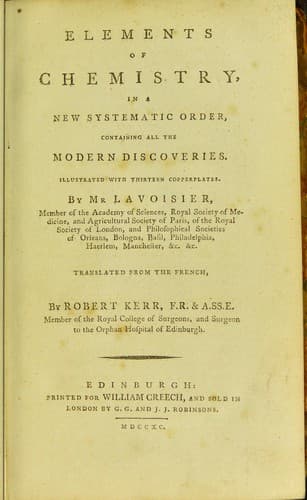
Elements of Chemistry,: In a New Systematic Order, Containing all the Modern DiscoveriesLavoisier, Antoine Laurent
Science
Elements of Chemistry,: In a New Systematic Order, Containing all the Modern Discoveries
Lavoisier, Antoine Laurent
Chemistry -- Early works to 1800
SECT. XIII.--_Observations upon the Nitrous and Nitric Acids, and their
Combinations._
The nitrous and nitric acids are procured from a neutral salt long known
in the arts under the name of _saltpetre_. This salt is extracted by
lixiviation from the rubbish of old buildings, from the earth of
cellars, stables, or barns, and in general of all inhabited places. In
these earths the nitric acid is usually combined with lime and magnesia,
sometimes with potash, and rarely with argill. As all these salts,
excepting the nitrat of potash, attract the moisture of the air, and
consequently would be difficultly preserved, advantage is taken, in the
manufactures of saltpetre and the royal refining house, of the greater
affinity of the nitric acid to potash than these other bases, by which
means the lime, magnesia, and argill, are precipitated, and all these
nitrats are reduced to the nitrat of potash or saltpetre[41].
The nitric acid is procured from this salt by distillation, from three
parts of pure saltpetre decomposed by one part of concentrated
sulphuric acid, in a retort with Woulfe's apparatus, (Pl. IV. fig. 1.)
having its bottles half filled with water, and all its joints carefully
luted. The nitrous acid passes over in form of red vapours surcharged
with nitrous gas, or, in other words, not saturated with oxygen. Part of
the acid condenses in the recipient in form of a dark orange red liquid,
while the rest combines with the water in the bottles. During the
distillation, a large quantity of oxygen gas escapes, owing to the
greater affinity of oxygen to caloric, in a high temperature, than to
nitrous acid, though in the usual temperature of the atmosphere this
affinity is reversed. It is from the disengagement of oxygen that the
nitric acid of the neutral salt is in this operation converted into
nitrous acid. It is brought back to the state of nitric acid by heating
over a gentle fire, which drives off the superabundant nitrous gas, and
leaves the nitric acid much diluted with water.
Nitric acid is procurable in a more concentrated state, and with much
less loss, by mixing very dry clay with saltpetre. This mixture is put
into an earthern retort, and distilled with a strong fire. The clay
combines with the potash, for which it has great affinity, and the
nitric acid passes over, slightly impregnated with nitrous gas. This is
easily disengaged by heating the acid gently in a retort, a small
quantity of nitrous gas passes over into the recipient, and very pure
concentrated nitric acid remains in the retort.
Public-domain text, read in full here on John Shaqi.
Reviews
Reviews
No reviews yet
Be the first to share your thoughts on this work.
Elsewhere in the archive
Join the Discussion
Join the discussion
Sign in to leave a comment or review.
Sign InorCreate an account