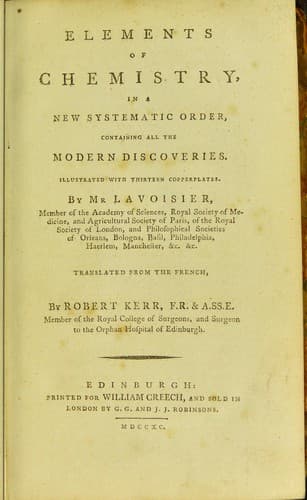
Elements of Chemistry,: In a New Systematic Order, Containing all the Modern DiscoveriesLavoisier, Antoine Laurent
Science
Elements of Chemistry,: In a New Systematic Order, Containing all the Modern Discoveries
Lavoisier, Antoine Laurent
Chemistry -- Early works to 1800
We have already seen that azote is the nitric radical. If to 20-1/2
parts, by weight, of azote 43-1/2 parts of oxygen be added, 64 parts of
nitrous gas are formed; and, if to this we join 36 additional parts of
oxygen, 100 parts of nitric acid result from the combination.
Intermediate quantities of oxygen between these two extremes of
oxygenation produce different species of nitrous acid, or, in other
words, nitric acid less or more impregnated with nitrous gas. I
ascertained the above proportions by means of decomposition; and, though
I cannot answer for their absolute accuracy, they cannot be far removed
from truth. Mr Cavendish, who first showed by synthetic experiments that
azote is the base of nitric acid, gives the proportions of azote a
little larger than I have done; but, as it is not improbable that he
produced the nitrous acid and not the nitric, that circumstance explains
in some degree the difference in the results of our experiments.
As, in all experiments of a philosophical nature, the utmost possible
degree of accuracy is required, we must procure the nitric acid for
experimental purposes, from nitre which has been previously purified
from all foreign matter. If, after distillation, any sulphuric acid is
suspected in the nitric acid, it is easily separated by dropping in a
little nitrat of barytes, so long as any precipitation takes place; the
sulphuric acid, from its greater affinity, attracts the barytes, and
forms with it an insoluble neutral salt, which falls to the bottom. It
may be purified in the same manner from muriatic acid, by dropping in a
little nitrat of silver so long as any precipitation of muriat of silver
is produced. When these two precipitations are finished, distill off
about seven-eighths of the acid by a gentle heat, and what comes over is
in the most perfect degree of purity.
The nitric acid is one of the most prone to combination, and is at the
same time very easily decomposed. Almost all the simple substances, with
the exception of gold, silver, and platina, rob it less or more of its
oxygen; some of them even decompose it altogether. It was very anciently
known, and its combinations have been more studied by chemists than
those of any other acid. These combinations were named _nitres_ by
Messrs Macquer and Beaume; but we have changed their names to nitrats
and nitrites, according as they are formed by nitric or by nitrous acid,
and have added the specific name of each particular base, to distinguish
the several combinations from each other.
TABLE _of the Combinations of Sulphuric Acid with the Salifiable Bases,
in the order of affinity._
_Names of the bases._ _Resulting compounds._
_New nomenclature._ _Old nomenclature._
Barytes Sulphat of barytes Heavy spar. Vitriol of heavy earth.
Potash potash {Vitriolated tartar. Sal
{ de duobus. Arcanum
{ duplicatam.
Public-domain text, read in full here on John Shaqi.
Reviews
Reviews
No reviews yet
Be the first to share your thoughts on this work.
Elsewhere in the archive
Join the Discussion
Join the discussion
Sign in to leave a comment or review.
Sign InorCreate an account