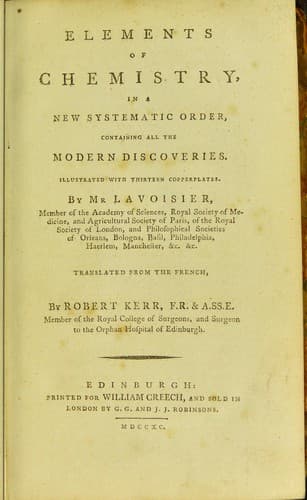
Elements of Chemistry,: In a New Systematic Order, Containing all the Modern DiscoveriesLavoisier, Antoine Laurent
Science
Elements of Chemistry,: In a New Systematic Order, Containing all the Modern Discoveries
Lavoisier, Antoine Laurent
Chemistry -- Early works to 1800
Potash potash {Effervescing or aerated fixe
{ vegetable alkali, mephitis of
{ potash.
Soda soda {Aerated or effervescing fixed mineral
{ alkali, mephitic soda.
Magnesia magnesia {Aerated, effervescing, mild, or
{ mephitic magnesia.
Ammoniac ammoniac {Aerated, effervescing, mild, or
{ mephitic volatile alkali.
Argill argill {Aerated or effervescing argillaceous
{ earth, or earth of alum.
Oxyds of
zinc zinc Zinc spar, mephitic or aerated zinc.
iron iron Sparry iron-ore, mephitic or aerated iron.
manganese manganese Aerated manganese.
cobalt cobalt Aerated cobalt.
nickel nickel Aerated nickel.
lead lead Sparry lead-ore, or aerated lead.
tin tin Aerated tin.
copper copper Aerated copper.
bismuth bismuth Aerated bismuth.
antimony antimony Aerated antimony.
arsenic arsenic Aerated arsenic.
mercury mercury Aerated mercury.
silver silver Aerated silver.
gold gold Aerated gold.
platina platina Aerated platina.
[Note A: As these salts have only been understood of late, they have
not, properly speaking, any old names. Mr Morveau, in the First Volume
of the Encyclopedia, calls them _Mephites_; Mr Bergman gives them the
name of _aerated_; and Mr de Fourcroy, who calls the carbonic acid
_chalky acid_, gives them the name of _chalks_.--A]
SECT. XVII.--_Observations upon Carbonic Acid, and its Combinations._
Of all the known acids, the carbonic is the most abundant in nature; it
exists ready formed in chalk, marble, and all the calcareous stones, in
which it is neutralized by a particular earth called _lime_. To
disengage it from this combination, nothing more is requisite than to
add some sulphuric acid, or any other which has a stronger affinity for
lime; a brisk effervescence ensues, which is produced by the
disengagement of the carbonic acid which assumes the state of gas
immediately upon being set free. This gas, incapable of being condensed
into the solid or liquid form by any degree of cold or of pressure
hitherto known, unites to about its own bulk of water, and thereby forms
a very weak acid. It may likewise be obtained in great abundance from
saccharine matter in fermentation, but is then contaminated by a small
portion of alkohol which it holds in solution.
Public-domain text, read in full here on John Shaqi.
Reviews
Reviews
No reviews yet
Be the first to share your thoughts on this work.
Elsewhere in the archive
Join the Discussion
Join the discussion
Sign in to leave a comment or review.
Sign InorCreate an account