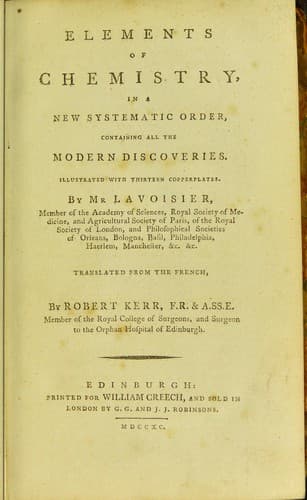
Elements of Chemistry,: In a New Systematic Order, Containing all the Modern DiscoveriesLavoisier, Antoine Laurent
Science
Elements of Chemistry,: In a New Systematic Order, Containing all the Modern Discoveries
Lavoisier, Antoine Laurent
Chemistry -- Early works to 1800
[Note A: The existence of metallic phosphites supposes that metals are
susceptible of solution in phosphoric acid at different degrees of
oxygenation, which is not yet ascertained.--A.]
[Note B: All the phosphites were unknown till lately, and consequently
have not hitherto received names.--A.]
[Note C: The greater part of the phosphats were only discovered of late,
and have not yet been named.--A.]
SECT. XVI.--_Observations upon Phosphorous and Phosphoric Acids, and
their Combinations._
Under the article Phosphorus, Part II. Sect. X. we have already given a
history of the discovery of that singular substance, with some
observations upon the mode of its existence in vegetable and animal
bodies. The best method of obtaining this acid in a state of purity is
by burning well purified phosphorus under bell-glasses, moistened on the
inside with distilled water; during combustion it absorbs twice and a
half its weight of oxygen; so that 100 parts of phosphoric acid is
composed of 28-1/2 parts of phosphorus united to 71-1/2 parts of oxygen.
This acid may be obtained concrete, in form of white flakes, which
greedily attract the moisture of the air, by burning phosphorus in a dry
glass over mercury.
To obtain phosphorous acid, which is phosphorus less oxygenated than in
the state of phosphoric acid, the phosphorus must be burnt by a very
slow spontaneous combustion over a glass-funnel leading into a crystal
phial; after a few days, the phosphorus is found oxygenated, and the
phosphorous acid, in proportion as it forms, has attracted moisture from
the air, and dropped into the phial. The phosphorous acid is readily
changed into phosphoric acid by exposure for a long time to the free
air; it absorbs oxygen from the air, and becomes fully oxygenated.
As phosphorus has a sufficient affinity for oxygen to attract it from
the nitric and muriatic acids, we may form phosphoric acid, by means of
these acids, in a very simple and cheap manner. Fill a tubulated
receiver, half full of concentrated nitric acid, and heat it gently,
then throw in small pieces of phosphorus through the tube, these are
dissolved with effervescence and red fumes of nitrous gas fly off; add
phosphorus so long as it will dissolve, and then increase the fire under
the retort to drive off the last particles of nitric acid; phosphoric
acid, partly fluid and partly concrete, remains in the retort.
TABLE _of the Combinations of Carbonic Acid, with the Salifiable Bases,
in the Order of Affinity._
_Names of_ _Resulting Neutral Salts._
_Bases_ _New Nomenclature._ _Old Nomenclature._
Barytes Carbonates of barytes(A) Aerated or effervescent heavy earth.
Lime lime {Chalk, calcareous spar,
{ Aerated calcareous earth.
Public-domain text, read in full here on John Shaqi.
Reviews
Reviews
No reviews yet
Be the first to share your thoughts on this work.
Elsewhere in the archive
Join the Discussion
Join the discussion
Sign in to leave a comment or review.
Sign InorCreate an account