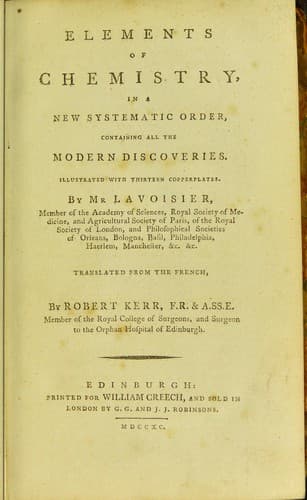
Elements of Chemistry,: In a New Systematic Order, Containing all the Modern DiscoveriesLavoisier, Antoine Laurent
Science
Elements of Chemistry,: In a New Systematic Order, Containing all the Modern Discoveries
Lavoisier, Antoine Laurent
Chemistry -- Early works to 1800
In the Collections of the Academy for 1746, Mr Macquer shows that, when
a mixture of white oxyd of arsenic and nitre are subjected to the action
of a strong fire, a neutral salt is obtained, which he calls _neutral
salt of arsenic_. At that time, the cause of this singular phenomenon,
in which a metal acts the part of an acid, was quite unknown; but more
modern experiments teach that, during this process, the arsenic becomes
oxygenated, by carrying off the oxygen of the nitric acid; it is thus
converted into a real acid, and combines with the potash. There are
other methods now known for oxygenating arsenic, and obtaining its acid
free from combination. The most simple and most effectual of these is as
follows: Dissolve white oxyd of arsenic in three parts, by weight, of
muriatic acid; to this solution, in a boiling state, add two parts of
nitric acid, and evaporate to dryness. In this process the nitric acid
is decomposed, its oxygen unites with the oxyd of arsenic, and converts
it into an acid, and the nitrous radical flies off in the state of
nitrous gas; whilst the muriatic acid is converted by the heat into
muriatic acid gas, and may be collected in proper vessels. The arseniac
acid is entirely freed from the other acids employed during the process
by heating it in a crucible till it begins to grow red; what remains is
pure concrete arseniac acid.
Mr Scheele's process, which was repeated with great success by Mr
Morveau, in the laboratory at Dijon, is as follows: Distil muriatic acid
from the black oxyd of manganese, this converts it into oxygenated
muriatic acid, by carrying off the oxygen from the manganese, receive
this in a recipient containing white oxyd of arsenic, covered by a
little distilled water; the arsenic decomposes the oxygenated muriatic
acid, by carrying off its supersaturation of oxygen, the arsenic is
converted into arseniac acid, and the oxygenated muriatic acid is
brought back to the state of common muriatic acid. The two acids are
separated by distillation, with a gentle heat increased towards the end
of the operation, the muriatic acid passes over, and the arseniac acid
remains behind in a white concrete form.
The arseniac acid is considerably less volatile than white oxyd of
arsenic; it often contains white oxyd of arsenic in solution, owing to
its not being sufficiently oxygenated; this is prevented by continuing
to add nitrous acid, as in the former process, till no more nitrous gas
is produced. From all these observations I would give the following
definition of arseniac acid. It is a white concrete metallic acid,
formed by the combination of arsenic with oxygen, fixed in a red heat,
soluble in water, and capable of combining with many of the salifiable
bases.
SECT. XXIV.--_Observations upon Molybdic Acid, and its Combinations with
Acidifiable Bases[43]._
Public-domain text, read in full here on John Shaqi.
Reviews
Reviews
No reviews yet
Be the first to share your thoughts on this work.
Elsewhere in the archive
Join the Discussion
Join the discussion
Sign in to leave a comment or review.
Sign InorCreate an account