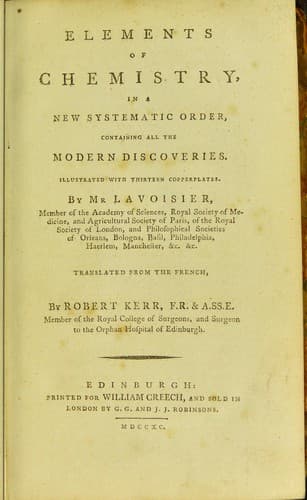
Elements of Chemistry,: In a New Systematic Order, Containing all the Modern DiscoveriesLavoisier, Antoine Laurent
Science
Elements of Chemistry,: In a New Systematic Order, Containing all the Modern Discoveries
Lavoisier, Antoine Laurent
Chemistry -- Early works to 1800
Molybdena is a particular metallic body, capable of being oxygenated, so
far as to become a true concrete acid[44]. For this purpose, one part
ore of molybdena, which is a natural sulphuret of that metal, is put
into a retort, with five or six parts nitric acid, diluted with a
quarter of its weight of water, and heat is applied to the retort; the
oxygen of the nitric acid acts both upon the molybdena and the sulphur,
converting the one into molybdic, and the other into sulphuric acid;
pour on fresh quantities of nitric acid so long as any red fumes of
nitrous gas escape; the molydbena is then oxygenated as far as is
possible, and is found at the bottom of the retort in a pulverulent
form, resembling chalk. It must be washed in warm water, to separate any
adhering particles of sulphuric acid; and, as it is hardly soluble, we
lose very little of it in this operation. All its combinations with
salifiable bases were unknown to the ancient chemists.
TABLE _of the Combinations of Tungstic Acid with the Salifiable Bases._
_Bases._ _Neutral Salts._
Lime Tungstat of lime.
Barytes barytes.
Magnesia magnesia.
Potash potash.
Soda soda.
Ammoniac ammoniac.
Argill argill.
Oxyd of antimony(A), &c. antimony(B), &c.
[Note A: The combinations with metallic oxyds were set down by Mr
Lavoisier in alphabetical order; their order of affinity being unknown,
I have omitted them, as serving no purpose.--E.]
[Note B: All these salts were unknown to the ancient chemists.--A.]
SECT. XXV.--_Observations upon Tungstic Acid, and its Combinations._
Tungstein is a particular metal, the ore of which has frequently been
confounded with that of tin. The specific gravity of this ore is to
water as 6 to 1; in its form of cristallization it resembles the
garnet, and varies in colour from a pearl-white to yellow and reddish;
it is found in several parts of Saxony and Bohemia. The mineral called
_Wolfram_, which is frequent in the mines of Cornwal, is likewise an ore
of this metal. In all these ores the metal is oxydated; and, in some of
them, it appears even to be oxygenated to the state of acid, being
combined with lime into a true tungstat of lime.
Public-domain text, read in full here on John Shaqi.
Reviews
Reviews
No reviews yet
Be the first to share your thoughts on this work.
Elsewhere in the archive
Join the Discussion
Join the discussion
Sign in to leave a comment or review.
Sign InorCreate an account