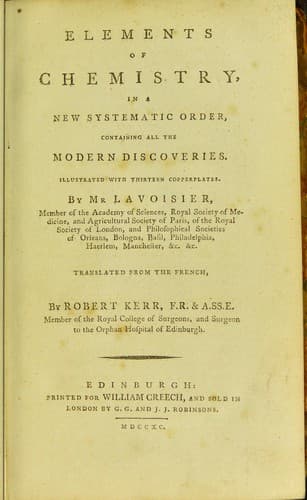
Elements of Chemistry,: In a New Systematic Order, Containing all the Modern DiscoveriesLavoisier, Antoine Laurent
Science
Elements of Chemistry,: In a New Systematic Order, Containing all the Modern Discoveries
Lavoisier, Antoine Laurent
Chemistry -- Early works to 1800
The citric acid is procured by expression from lemons, and is found in
the juices of many other fruits mixed with malic acid. To obtain it pure
and concentrated, it is first allowed to depurate from the mucous part
of the fruit by long rest in a cool cellar, and is afterwards
concentrated by exposing it to the temperature of 4 or 5 degrees below
Zero, from 21 deg. to 23 deg. of Fahrenheit, the water is frozen, and
the acid remains liquid, reduced to about an eighth part of its original
bulk. A lower degree of cold would occasion the acid to be engaged
amongst the ice, and render it difficultly separable. This process was
pointed out by Mr Georgius.
It is more easily obtained by saturating the lemon-juice with lime, so
as to form a citrat of lime, which is insoluble in water; wash this
salt, and pour on a proper quantity of sulphuric acid; this forms a
sulphat of lime, which precipitates and leaves the citric acid free in
the liquor.
TABLE _of the Combinations of Pyro-lignous Acid with the Salifiable
Bases, in the Order of Affinity(A)._
_Bases._ _Neutral Salts._
Lime Pyro-mucite of lime.
Barytes barytes.
Potash potash.
Soda soda.
Magnesia magnesia.
Ammoniac ammoniac.
Oxyd of
zinc zinc.
manganese manganese.
iron iron.
lead lead.
tin tin.
cobalt cobalt.
copper copper.
nickel nickel.
arsenic arsenic.
bismuth bismuth.
mercury mercury.
antimony antimony.
silver silver.
gold gold.
platina platina.
Argill argill.
[Note A: The above affinities were determined by Messrs de Morveau and
EloI Boursier de Clervaux. These combinations were entirely unknown till
lately.--A.]
SECT. XXIX.--_Observations upon Pyro-lignous Acid, and its
Combinations._
The ancient chemists observed that most of the woods, especially the
more heavy and compact ones, gave out a particular acid spirit, by
distillation, in a naked fire; but, before Mr Goetling, who gives an
account of his experiments upon this subject in Crell's Chemical Journal
for 1779, no one had ever made any inquiry into its nature and
properties. This acid appears to be the same, whatever be the wood it is
procured from. When first distilled, it is of a brown colour, and
considerably impregnated with charcoal and oil; it is purified from
these by a second distillation. The pyro-lignous radical is chiefly
composed of hydrogen and charcoal.
Public-domain text, read in full here on John Shaqi.
Reviews
Reviews
No reviews yet
Be the first to share your thoughts on this work.
Elsewhere in the archive
Join the Discussion
Join the discussion
Sign in to leave a comment or review.
Sign InorCreate an account