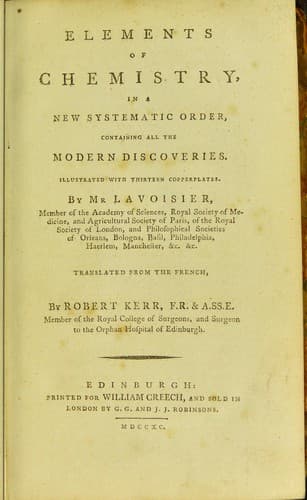
Elements of Chemistry,: In a New Systematic Order, Containing all the Modern DiscoveriesLavoisier, Antoine Laurent
Science
Elements of Chemistry,: In a New Systematic Order, Containing all the Modern Discoveries
Lavoisier, Antoine Laurent
Chemistry -- Early works to 1800
SECT. XXX.--_Observations upon Pyro-tartarous Acid, and its Combinations
with the Salifiable Bases[46]._
The name of _Pyro-tartarous acid_ is given to a dilute empyreumatic acid
obtained from purified acidulous tartarite of potash by distillation in
a naked fire. To obtain it, let a retort be half filled with powdered
tartar, adapt a tubulated recipient, having a bent tube communicating
with a bell-glass in a pneumato-chemical apparatus; by gradually raising
the fire under the retort, we obtain the pyro-tartarous acid mixed with
oil, which is separated by means of a funnel. A vast quantity of
carbonic acid gas is disengaged during the distillation. The acid
obtained by the above process is much contaminated with oil, which ought
to be separated from it. Some authors advise to do this by a second
distillation; but the Dijon academicians inform us, that this is
attended with great danger from explosions which take place during the
process.
TABLE _of the Combinations of Pyro-mucous Acid, with the Salifiable
Bases, in the Order of Affinity(A)._
_Bases._ _Neutral Salts._
Potash Pyro-mucite of potash.
Soda soda.
Barytes barytes.
Lime lime.
Magnesia magnesia.
Ammoniac ammoniac.
Argill argill.
Oxyd of
zinc zinc.
manganese manganese.
iron iron.
lead lead.
tin tin.
cobalt cobalt.
copper copper.
nickel nickel.
arsenic arsenic.
bismuth bismuth.
antimony antimony.
[Note A: All these combinations were unknown to the ancient
chemists.--A.]
SECT. XXXI.--_Observations upon Pyro-mucous Acid, and its Combinations._
This acid is obtained by distillation in a naked fire from sugar, and
all the saccharine bodies; and, as these substances swell greatly in the
fire, it is necessary to leave seven-eighths of the retort empty. It is
of a yellow colour, verging to red, and leaves a mark upon the skin,
which will not remove but alongst with the epidermis. It may be procured
less coloured, by means of a second distillation, and is concentrated by
freezing, as is directed for the citric acid. It is chiefly composed of
water and oil slightly oxygenated, and is convertible into oxalic and
malic acids by farther oxygenation with the nitric acid.
It has been pretended that a large quantity of gas is disengaged during
the distillation of this acid, which is not the case if it be conducted
slowly, by means of moderate heat.
Public-domain text, read in full here on John Shaqi.
Reviews
Reviews
No reviews yet
Be the first to share your thoughts on this work.
Elsewhere in the archive
Join the Discussion
Join the discussion
Sign in to leave a comment or review.
Sign InorCreate an account