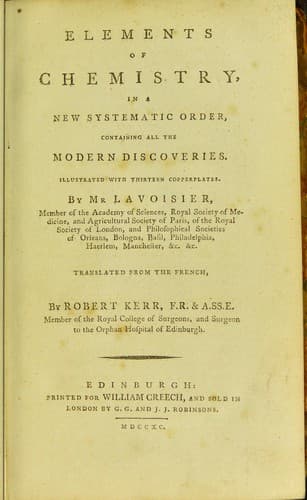
Elements of Chemistry,: In a New Systematic Order, Containing all the Modern DiscoveriesLavoisier, Antoine Laurent
Science
Elements of Chemistry,: In a New Systematic Order, Containing all the Modern Discoveries
Lavoisier, Antoine Laurent
Chemistry -- Early works to 1800
+---------------+------------------+---------------------------------------+
From the liquor remaining after the first cristallization of the oxalic
acid we may obtain malic acid by refrigeration: This acid is more
oxygenated than the oxalic; and, by a further oxygenation, the sugar is
convertible into acetous acid, or vinegar.
The oxalic acid, combined with a small quantity of soda or potash, has
the property, like the tartarous acid, of entering into a number of
combinations without suffering decomposition: These combinations form
triple salts, or neutral salts with double bases, which ought to have
proper names. The salt of sorrel, which is potash having oxalic acid
combined in excess, is named acidulous oxalat of potash in our new
nomenclature.
The acid procured from sorrel has been known to chemists for more than a
century, being mentioned by Mr Duclos in the Memoirs of the Academy for
1688, and was pretty accurately described by Boerhaave; but Mr Scheele
first showed that it contained potash, and demonstrated its identity
with the acid formed by the oxygenation of sugar.
SECT. XXXIII.--_Observations upon Acetous Acid, and its Combinations._
This acid is composed of charcoal and hydrogen united together, and
brought to the state of an acid by the addition of oxygen; it is
consequently formed by the same elements with the tartarous oxalic,
citric, malic acids, and others, but the elements exist in different
proportions in each of these; and it would appear that the acetous acid
is in a higher state of oxygenation than these other acids. I have some
reason to believe that the acetous radical contains a small portion of
azote; and, as this element is not contained in the radicals of any
vegetable acid except the tartarous, this circumstance is one of the
causes of difference. The acetous acid, or vinegar, is produced by
exposing wine to a gentle heat, with the addition of some ferment: This
is usually the ley, or mother, which has separated from other vinegar
during fermentation, or some similar matter. The spiritous part of the
wine, which consists of charcoal and hydrogen, is oxygenated, and
converted into vinegar: This operation can only take place with free
access of air, and is always attended by a diminution of the air
employed in consequence of the absorption of oxygen; wherefore, it ought
always to be carried on in vessels only half filled with the vinous
liquor submitted to the acetous fermentation. The acid formed during
this process is very volatile, is mixed with a large proportion of
water, and with many foreign substances; and, to obtain it pure, it is
distilled in stone or glass vessels by a gentle fire. The acid which
passes over in distillation is somewhat changed by the process, and is
not exactly of the same nature with what remains in the alembic, but
seems less oxygenated: This circumstance has not been formerly observed
by chemists.
Public-domain text, read in full here on John Shaqi.
Reviews
Reviews
No reviews yet
Be the first to share your thoughts on this work.
Elsewhere in the archive
Join the Discussion
Join the discussion
Sign in to leave a comment or review.
Sign InorCreate an account