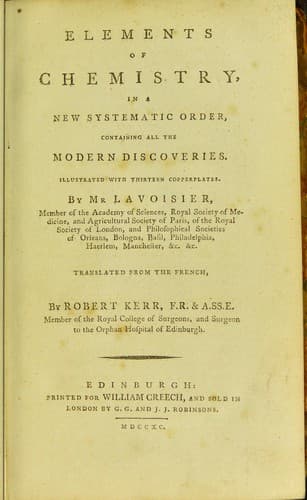
Elements of Chemistry,: In a New Systematic Order, Containing all the Modern DiscoveriesLavoisier, Antoine Laurent
Science
Elements of Chemistry,: In a New Systematic Order, Containing all the Modern Discoveries
Lavoisier, Antoine Laurent
Chemistry -- Early works to 1800
Distillation is not sufficient for depriving this acid of all its
unnecessary water; and, for this purpose, the best way is by exposing it
to a degree of cold from 4 deg. to 6 deg. below the freezing point, from
19 deg. to 23 deg. of Fahrenheit; by this means the aqueous part becomes
frozen, and leaves the acid in a liquid state, and considerably
concentrated. In the usual temperature of the air, this acid can only
exist in the gasseous form, and can only be retained by combination with
a large proportion of water. There are other chemical processes for
obtaining the acetous acid, which consist in oxygenating the tartarous,
oxalic, or malic acids, by means of nitric acid; but there is reason to
believe the proportions of the elements of the radical are changed
during this process. Mr Hassenfratz is at present engaged in repeating
the experiments by which these conversions are said to be produced.
The combinations of acetous acid with the various salifiable bases are
very readily formed; but most of the resulting neutral salts are not
cristallizable, whereas those produced by the tartarous and oxalic acids
are, in general, hardly soluble. Tartarite and oxalat of lime are not
soluble in any sensible degree: The malats are a medium between the
oxalats and acetites, with respect to solubility, and the malic acid is
in the middle degree of saturation between the oxalic and acetous acids.
With this, as with all the acids, the metals require to be oxydated
previous to solution.
The ancient chemists knew hardly any of the salts formed by the
combinations of acetous acid with the salifiable bases, except the
acetites of potash, soda, ammoniac, copper, and lead. Mr Cadet
discovered the acetite of arsenic[47]; Mr Wenzel, the Dijon academicians
Mr de Lassone, and Mr Proust, made us acquainted with the properties of
the other acetites. From the property which acetite of potash possesses,
of giving out ammoniac in distillation, there is some reason to suppose,
that, besides charcoal and hydrogen, the acetous radical contains a
small proportion of azote, though it is not impossible but the above
production of ammoniac may be occasioned by the decomposition of the
potash.
TABLE _of the Combinations of Acetic Acid with the Salifiable Bases, in
the order of affinity._
_Bases._ _Neutral Salts._
Barytes Acetat of barytes.
Potash potash.
Soda soda.
Lime lime.
Magnesia magnesia.
Ammoniac ammoniac.
Oxyd of zinc zinc.
manganese manganese.
iron iron.
lead lead.
tin tin.
cobalt cobalt.
copper copper.
nickel nickel.
arsenic arsenic.
bismuth bismuth.
mercury mercury.
antimony antimony.
silver silver.
gold gold.
platina platina.
Argill argill.
Public-domain text, read in full here on John Shaqi.
Reviews
Reviews
No reviews yet
Be the first to share your thoughts on this work.
Elsewhere in the archive
Join the Discussion
Join the discussion
Sign in to leave a comment or review.
Sign InorCreate an account