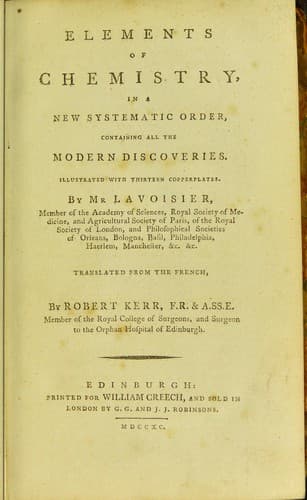
Elements of Chemistry,: In a New Systematic Order, Containing all the Modern DiscoveriesLavoisier, Antoine Laurent
Science
Elements of Chemistry,: In a New Systematic Order, Containing all the Modern Discoveries
Lavoisier, Antoine Laurent
Chemistry -- Early works to 1800
The Gallic acid, formerly called Principle of Astringency, is obtained
from gall nuts, either by infusion or decoction with water, or by
distillation with a very gentle heat. This acid has only been attended
to within these few years. The Committee of the Dijon Academy have
followed it through all its combinations, and give the best account of
it hitherto produced. Its acid properties are very weak; it reddens the
tincture of turnsol, decomposes sulphurets, and unites to all the metals
when they have been previously dissolved in some other acid. Iron, by
this combination, is precipitated of a very deep blue or violet colour.
The radical of this acid, if it deserves the name of one, is hitherto
entirely unknown; it is contained in oak willow, marsh iris, the
strawberry, nymphea, Peruvian bark, the flowers and bark of pomgranate,
and in many other woods and barks.
SECT. XXXIX.--_Observations upon Lactic Acid, and its Combinations with
Salifiable Bases[51]._
The only accurate knowledge we have of this acid is from the works of Mr
Scheele. It is contained in whey, united to a small quantity of earth,
and is obtained as follows: Reduce whey to one eighth part of its bulk
by evaporation, and filtrate, to separate all its cheesy matter; then
add as much lime as is necessary to combine with the acid; the lime is
afterwards disengaged by the addition of oxalic acid, which combines
with it into an insoluble neutral salt. When the oxalat of lime has been
separated by decantation, evaporate the remaining liquor to the
consistence of honey; the lactic acid is dissolved by alkohol, which
does not unite with the sugar of milk and other foreign matters; these
are separated by filtration from the alkohol and acid; and the alkohol
being evaporated, or distilled off, leaves the lactic acid behind.
This acid unites with all the salifiable bases forming salts which do
not cristallize; and it seems considerably to resemble the acetous
acid.
TABLE _of the Combinations of Saccholactic Acid with the Salifiable
Bases, in the Order of Affinity._
_Bases._ _Neutral Salts._
Lime Saccholat of lime.
Barytes barytes.
Magnesia magnesia.
Potash potash.
Soda soda.
Ammoniac ammoniac.
Argill argill.
Oxyd of zinc zinc.
manganese manganese.
iron iron.
lead lead.
tin tin.
cobalt cobalt.
copper copper.
nickel nickel.
arsenic arsenic.
bismuth bismuth.
mercury mercury.
antimony antimony.
silver silver.
Public-domain text, read in full here on John Shaqi.
Reviews
Reviews
No reviews yet
Be the first to share your thoughts on this work.
Elsewhere in the archive
Join the Discussion
Join the discussion
Sign in to leave a comment or review.
Sign InorCreate an account