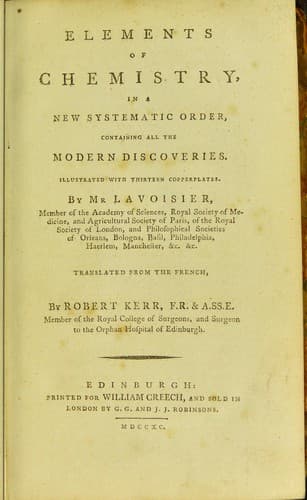
Elements of Chemistry,: In a New Systematic Order, Containing all the Modern DiscoveriesLavoisier, Antoine Laurent
Science
Elements of Chemistry,: In a New Systematic Order, Containing all the Modern Discoveries
Lavoisier, Antoine Laurent
Chemistry -- Early works to 1800
This acid is soluble in twenty-four times its weight of cold water, and
in a much smaller quantity of hot water. It possesses the qualities of
an acid in a very small degree, and only affects the blue vegetable
colours very slightly. The affinities of this acid, with the salifiable
bases, are taken from Mr de Morveau, who is the first chemist that has
endeavoured to ascertain them.
SECT. XXXVI.--_Observations upon Benzoic Acid, and its Combinations with
Salifiable Bases[48]._
This acid was known to the ancient chemists under the name of Flowers of
Benjamin, or of Benzoin, and was procured, by sublimation, from the gum
or resin called Benzoin: The means of procuring it, _via humida_, was
discovered by Mr Geoffroy, and perfected by Mr Scheele. Upon benzoin,
reduced to powder, pour strong lime-water, having rather an excess of
lime; keep the mixture continually stirring, and, after half an hour's
digestion, pour off the liquor, and use fresh portions of lime-water in
the same manner, so long as there is any appearance of neutralization.
Join all the decanted liquors, and evaporate, as far as possible,
without occasioning cristallization, and, when the liquor is cold, drop
in muriatic acid till no more precipitate is formed. By the former part
of the process a benzoat of lime is formed, and, by the latter, the
muriatic acid combines with the lime, forming muriat of lime, which
remains dissolved, while the benzoic acid, being insoluble,
precipitates in a concrete state.
SECT. XXXVII.--_Observations upon Camphoric Acid, and its Combinations
with Salifiable Bases[49]._
Camphor is a concrete essential oil, obtained, by sublimation, from a
species of laurus which grows in China and Japan. By distilling nitric
acid eight times from camphor, Mr Kosegarten converted it into an acid
analogous to the oxalic; but, as it differs from that acid in some
circumstances, we have thought necessary to give it a particular name,
till its nature be more completely ascertained by farther experiment.
As camphor is a carbono-hydrous or hydro-carbonous radical, it is easily
conceived, that, by oxygenation, it should form oxalic, malic, and
several other vegetable acids: This conjecture is rendered not
improbable by the experiments of Mr Kosegarten; and the principal
phenomena exhibited in the combinations of camphoric acid with the
salifiable bases, being very similar to those of the oxalic and malic
acids, lead me to believe that it consists of a mixture of these two
acids.
SECT. XXXVIII.--_Observations upon Gallic Acid, and its Combinations
with Salifiable Bases[50]._
Public-domain text, read in full here on John Shaqi.
Reviews
Reviews
No reviews yet
Be the first to share your thoughts on this work.
Elsewhere in the archive
Join the Discussion
Join the discussion
Sign in to leave a comment or review.
Sign InorCreate an account