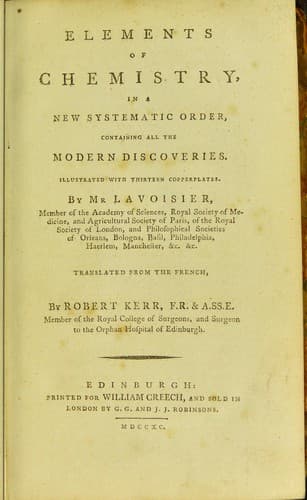
Elements of Chemistry,: In a New Systematic Order, Containing all the Modern DiscoveriesLavoisier, Antoine Laurent
Science
Elements of Chemistry,: In a New Systematic Order, Containing all the Modern Discoveries
Lavoisier, Antoine Laurent
Chemistry -- Early works to 1800
From the later experiments of Bergman and Scheele, the urinary calculus
appears to be a species of salt with an earthy basis; it is slightly
acidulous, and requires a large quantity of water for solution, three
grains being scarcely soluble in a thousand grains of boiling water, and
the greater part again cristallizes when cold. To this concrete acid,
which Mr de Morveau calls Lithiasic Acid, we give the name of Lithic
Acid, the nature and properties of which are hitherto very little known.
There is some appearance that it is an acidulous neutral salt, or acid
combined in excess with a salifiable base; and I have reason to believe
that it really is an acidulous phosphat of lime; if so, it must be
excluded from the class of peculiar acids.
TABLE _of the Combinations of the Prussic Acid with the Salifiable
Bases, in the order of affinity._
_Bases._ _Neutral Salts._
Potash Prussiat of potash.
Soda soda.
Ammoniac ammoniac.
Lime lime.
Barytes barytes.
Magnesia magnesia.
Oxyd of zinc zinc.
iron iron.
manganese manganese.
cobalt cobalt.
nickel nickel.
lead lead.
tin tin.
copper copper.
bismuth bismuth.
antimony antimony.
arsenic arsenic.
silver silver.
mercury mercury.
gold gold.
platina platina.
_Note._---All these were unknown to former chemists.--A.
_Observations upon the Prussic Acid, and its Combinations._
As the experiments which have been made hitherto upon this acid seem
still to leave a considerable degree of uncertainty with regard to its
nature, I shall not enlarge upon its properties, and the means of
procuring it pure and dissengaged from combination. It combines with
iron, to which it communicates a blue colour, and is equally susceptible
of entering into combination with most of the other metals, which are
precipitated from it by the alkalies, ammoniac, and lime, in consequence
of greater affinity. The Prussic radical, from the experiments of
Scheele, and especially from those of Mr Berthollet, seems composed of
charcoal and azote; hence it is an acid with a double base. The
phosphorus which has been found combined with it appears, from the
experiments of Mr Hassenfratz, to be only accidental.
Public-domain text, read in full here on John Shaqi.
Reviews
Reviews
No reviews yet
Be the first to share your thoughts on this work.
Elsewhere in the archive
Join the Discussion
Join the discussion
Sign in to leave a comment or review.
Sign InorCreate an account