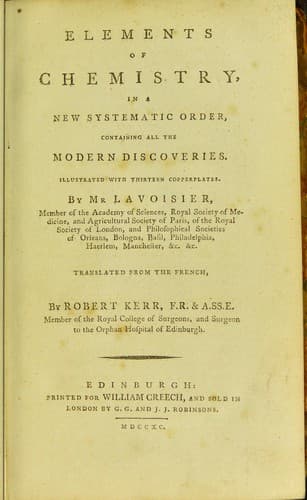
Elements of Chemistry,: In a New Systematic Order, Containing all the Modern DiscoveriesLavoisier, Antoine Laurent
Science
Elements of Chemistry,: In a New Systematic Order, Containing all the Modern Discoveries
Lavoisier, Antoine Laurent
Chemistry -- Early works to 1800
Although this acid combines with alkalies, earths, and metals, in the
same way with other acids, it possesses only some of the properties we
have been in use to attribute to acids, and it may consequently be
improperly ranked here in the class of acids; but, as I have already
observed, it is difficult to form a decided opinion upon the nature of
this substance until the subject has been farther elucidated by a
greater number of experiments.
FOOTNOTES:
[36] See Memoirs of the Academy for 1776, p. 671. and for 1778, p.
535,--A.
[37] See Part I. Chap. XI. upon this subject.--A.
[38] See Part I. Chap. XI. upon the application of these names according
to the proportions of the two ingredients.--A
[39] See Part I. Chap. XII. upon this subject.--A.
[40] Those who wish to see what has been said upon this great chemical
question by Messrs de Morveau, Berthollet, De Fourcroy, and myself, may
consult our translation of Mr Kirwan's Essay upon Phlogiston.--A.
[41] Saltpetre is likewise procured in large quantities by lixiviating
the natural soil in some parts of Bengal, and of the Russian Ukrain.--E.
[42] Commonly called _Derbyshire spars_.--E.
[43] I have not added the Table of these combinations, as the order of
their affinity is entirely unknown; they are called _molybdats of
argil_, _antimony_, _potash_, &c.--E.
[44] This acid was discovered by Mr Scheele, to whom chemistry is
indebted for the discovery of several other acids.--A.
[45] I have omitted the Table, as the order of affinity is unknown, and
is given by Mr Lavoisier only in alphabetical order. All the
combinations of malic acid with salifiable bases, which are named
_malats_, were unknown to the ancient chemists.--E.
[46] The order of affinity of the salifiable bases with this acid is
hitherto unknown. Mr Lavoisier, from its similarity to pyro-lignous
acid, supposes the order to be the same in both; but, as this is not
ascertained by experiment, the table is omitted. All these combinations,
called _Pyro-tartarites_, were unknown till lately--E.
[47] Savans Etrangers, Vol. III.
[48] These combinations are called Benzoats of Lime, Potash, Zinc, &c.;
but, as the order of affinity is unknown, the alphabetical table is
omitted, as unnecessary.--E.
[49] These combinations, which were all unknown to the ancients, are
called Camphorats. The table is omitted, as being only in alphabetical
order.--E.
[50] These combinations, which are called Gallats, were all unknown to
the ancients; and the order of their affinity is not hitherto
established.--A.
[51] These combinations are called Lactats; they were all unknown to the
ancient chemists, and their affinities have not yet been
ascertained.--A.
[52] These combinations named Bombats were unknown to the ancient
chemists; and the affinities of the salifiable bases with the bombic
acid are hitherto undetermined.--A.
Public-domain text, read in full here on John Shaqi.
Reviews
Reviews
No reviews yet
Be the first to share your thoughts on this work.
Elsewhere in the archive
Join the Discussion
Join the discussion
Sign in to leave a comment or review.
Sign InorCreate an account