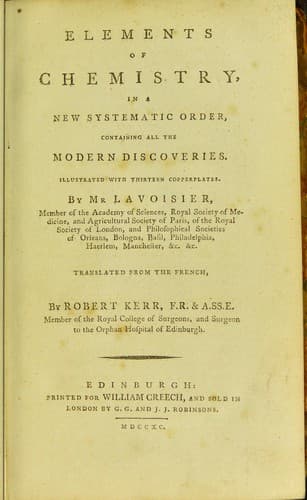
Elements of Chemistry,: In a New Systematic Order, Containing all the Modern DiscoveriesLavoisier, Antoine Laurent
Science
Elements of Chemistry,: In a New Systematic Order, Containing all the Modern Discoveries
Lavoisier, Antoine Laurent
Chemistry -- Early works to 1800
Chemical operations may be naturally divided into several classes,
according to the purposes they are intended for performing. Some may be
considered as purely mechanical, such as the determination of the weight
and bulk of bodies, trituration, levigation, searching, washing,
filtration, &c. Others may be considered as real chemical operations,
because they are performed by means of chemical powers and agents; such
are solution, fusion, &c. Some of these are intended for separating the
elements of bodies from each other, some for reuniting these elements
together; and some, as combustion, produce both these effects during the
same process.
Without rigorously endeavouring to follow the above method, I mean to
give a detail of the chemical operations in such order of arrangement as
seemed best calculated for conveying instruction. I shall be more
particular in describing the apparatus connected with modern chemistry,
because these are hitherto little known by men who have devoted much of
their time to chemistry, and even by many professors of the science.
CHAP. I.
_Of the Instruments necessary for determining the Absolute and Specific
Gravities of Solid and Liquid Bodies._
The best method hitherto known for determining the quantities of
substances submitted to chemical experiment, or resulting from them, is
by means of an accurately constructed beam and scales, with properly
regulated weights, which well known operation is called _weighing_. The
denomination and quantity of the weights used as an unit or standard for
this purpose are extremely arbitrary, and vary not only in different
kingdoms, but even in different provinces of the same kingdom, and in
different cities of the same province. This variation is of infinite
consequence to be well understood in commerce and in the arts; but, in
chemistry, it is of no moment what particular denomination of weight be
employed, provided the results of experiments be expressed in convenient
fractions of the same denomination. For this purpose, until all the
weights used in society be reduced to the same standard, it will be
sufficient for chemists in different parts to use the common pound of
their own country as the unit or standard, and to express all its
fractional parts in decimals, instead of the arbitrary divisions now in
use. By this means the chemists of all countries will be thoroughly
understood by each other, as, although the absolute weights of the
ingredients and products cannot be known, they will readily, and without
calculation, be able to determine the relative proportions of these to
each other with the utmost accuracy; so that in this way we shall be
possessed of an universal language for this part of chemistry.
Public-domain text, read in full here on John Shaqi.
Reviews
Reviews
No reviews yet
Be the first to share your thoughts on this work.
Elsewhere in the archive
Join the Discussion
Join the discussion
Sign in to leave a comment or review.
Sign InorCreate an account