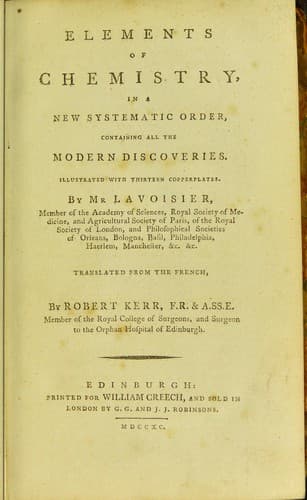
Elements of Chemistry,: In a New Systematic Order, Containing all the Modern DiscoveriesLavoisier, Antoine Laurent
Science
Elements of Chemistry,: In a New Systematic Order, Containing all the Modern Discoveries
Lavoisier, Antoine Laurent
Chemistry -- Early works to 1800
[53] All the combinations of this acid, should it finally turn out to be
one, were unknown to the ancient chemists, and its affinities with the
salifiable bases have not been hitherto determined.--A.
PART III.
Description of the Instruments and Operations of Chemistry.
INTRODUCTION.
In the two former parts of this work I designedly avoided being
particular in describing the manual operations of chemistry, because I
had found from experience, that, in a work appropriated to reasoning,
minute descriptions of processes and of plates interrupt the chain of
ideas, and render the attention necessary both difficult and tedious to
the reader. On the other hand, if I had confined myself to the summary
descriptions hitherto given, beginners could have only acquired very
vague conceptions of practical chemistry from my work, and must have
wanted both confidence and interest in operations they could neither
repeat nor thoroughly comprehend. This want could not have been
supplied from books; for, besides that there are not any which describe
the modern instruments and experiments sufficiently at large, any work
that could have been consulted would have presented these things under a
very different order of arrangement, and in a different chemical
language, which must greatly tend to injure the main object of my
performance.
Influenced by these motives, I determined to reserve, for a third part
of my work, a summary description of all the instruments and
manipulations relative to elementary chemistry. I considered it as
better placed at the end, rather than at the beginning of the book,
because I must have been obliged to suppose the reader acquainted with
circumstances which a beginner cannot know, and must therefore have read
the elementary part to become acquainted with. The whole of this third
part may therefore be considered as resembling the explanations of
plates which are usually placed at the end of academic memoirs, that
they may not interrupt the connection of the text by lengthened
description. Though I have taken great pains to render this part clear
and methodical, and have not omitted any essential instrument or
apparatus, I am far from pretending by it to set aside the necessity of
attendance upon lectures and laboratories, for such as wish to acquire
accurate knowledge of the science of chemistry. These should familiarise
themselves to the employment of apparatus, and to the performance of
experiments by actual experience. _Nihil est in intellectu quod non
prius fuerit in sensu_, the motto which the celebrated Rouelle caused to
be painted in large characters in a conspicuous part of his laboratory,
is an important truth never to be lost sight of either by teachers or
students of chemistry.
Public-domain text, read in full here on John Shaqi.
Reviews
Reviews
No reviews yet
Be the first to share your thoughts on this work.
Elsewhere in the archive
Join the Discussion
Join the discussion
Sign in to leave a comment or review.
Sign InorCreate an account