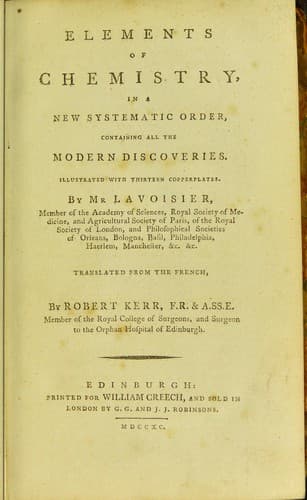
Elements of Chemistry,: In a New Systematic Order, Containing all the Modern DiscoveriesLavoisier, Antoine Laurent
Science
Elements of Chemistry,: In a New Systematic Order, Containing all the Modern Discoveries
Lavoisier, Antoine Laurent
Chemistry -- Early works to 1800
After several trials of different materials, I have found marble the
best substance for constructing the mercurial pneumato-chemical
apparatus, as it is perfectly impenetrable by mercury, and is not
liable, like wood, to separate at the junctures, or to allow the mercury
to escape through chinks; neither does it run the risk of breaking, like
glass, stone-ware, or porcelain. Take a block of marble BCDE, Plate V.
Fig. 3. and 4. about two feet long, 15 or 18 inches broad, and ten
inches thick, and cause it to be hollowed out as at m n Fig. 5. about
four inches deep, as a reservoir for the mercury; and, to be able more
conveniently to fill the jars, cut the gutter T V, Fig. 3. 4. and 5. at
least four inches deeper; and, as this trench may sometimes prove
troublesome, it is made capable of being covered at pleasure by thin
boards, which slip into the grooves x y, Fig. 5. I have two marble
cisterns upon this construction, of different sizes, by which I can
always employ one of them as a reservoir of mercury, which it preserves
with more safety than any other vessel, being neither subject to
overturn, nor to any other accident. We operate with mercury in this
apparatus exactly as with water in the one before described; but the
bell-glasses must be of smaller diameter, and much stronger; or we may
use glass tubes, having their mouths widened, as in Fig. 7.; these are
called _eudiometers_ by the glass-men who sell them. One of the
bell-glasses is represented Fig. 5. A. standing in its place, and what
is called a jar is engraved Fig. 6.
The mercurial pneumato-chemical apparatus is necessary in all
experiments wherein the disengaged gasses are capable of being absorbed
by water, as is frequently the case, especially in all combinations,
excepting those of metals, in fermentation, &c.
SECT. II.
_Of the Gazometer._
I give the name of _gazometer_ to an instrument which I invented, and
caused construct, for the purpose of a kind of bellows, which might
furnish an uniform and continued stream of oxygen gas in experiments of
fusion. Mr Meusnier and I have since made very considerable corrections
and additions, having converted it into what may be called an _universal
instrument_, without which it is hardly possible to perform most of the
very exact experiments. The name we have given the instrument indicates
its intention for measuring the volume or quantity of gas submitted to
it for examination.
Public-domain text, read in full here on John Shaqi.
Reviews
Reviews
No reviews yet
Be the first to share your thoughts on this work.
Elsewhere in the archive
Join the Discussion
Join the discussion
Sign in to leave a comment or review.
Sign InorCreate an account