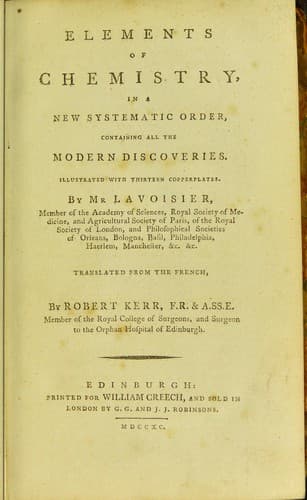
Elements of Chemistry,: In a New Systematic Order, Containing all the Modern DiscoveriesLavoisier, Antoine Laurent
Science
Elements of Chemistry,: In a New Systematic Order, Containing all the Modern Discoveries
Lavoisier, Antoine Laurent
Chemistry -- Early works to 1800
It consists of a strong iron beam, DE, Pl. VIII. Fig. 1. three feet
long, having at each end, D and E, a segment of a circle, likewise
strongly constructed of iron, and very firmly joined. Instead of being
poised as in ordinary balances, this beam rests, by means of a
cylindrical axis of polished steel, F, Fig. 9. upon two large moveable
brass friction-wheels, by which the resistance to its motion from
friction is considerably diminished, being converted into friction of
the second order. As an additional precaution, the parts of these wheels
which support the axis of the beam are covered with plates of polished
rock-cristal. The whole of this machinery is fixed to the top of the
solid column of wood BC, Fig. 1. To one extremity D of the beam, a scale
P for holding weights is suspended by a flat chain, which applies to the
curvature of the arc nDo, in a groove made for the purpose. To the
other extremity E of the beam is applied another flat chain, i k m, so
constructed, as to be incapable of lengthening or shortening, by being
less or more charged with weight; to this chain, an iron trivet, with
three branches, a i, c i, and h i, is strongly fixed at i, and
these branches support a large inverted jar A, of hammered copper, of
about 18 inches diameter, and 20 inches deep. The whole of this machine
is represented in perspective, Pl. VIII. Fig. 1. and Pl. IX. Fig. 2. and
4. give perpendicular sections, which show its interior structure.
Round the bottom of the jar, on its outside, is fixed (Pl. IX. Fig. 2.)
a border divided into compartments 1, 2, 3, 4, &c. intended to receive
leaden weights separately represented 1, 2, 3, Fig. 3. These are
intended for increasing the weight of the jar when a considerable
pressure is requisite, as will be afterwards explained, though such
necessity seldom occurs. The cylindrical jar A is entirely open below,
de, Pl. IX. Fig. 4.; but is closed above with a copper lid, a b c,
open at b f, and capable of being shut by the cock g. This lid, as may
be seen by inspecting the figures, is placed a few inches within the top
of the jar to prevent the jar from being ever entirely immersed in the
water, and covered over. Were I to have this instrument made over again,
I should cause the lid to be considerably more flattened, so as to be
almost level. This jar or reservoir of air is contained in the
cylindrical copper vessel, LMNO, Pl. VIII. Fig. 1. filled with water.
In the middle of the cylindrical vessel LMNO, Pl. IX. Fig. 4. are placed
two tubes st, xy, which are made to approach each other at their upper
extremities t y; these are made of such a length as to rise a little
above the upper edge LM of the vessel LMNO, and when the jar abcde
touches the bottom NO, their upper ends enter about half an inch into
the conical hollow b, leading to the stop-cock g.
Public-domain text, read in full here on John Shaqi.
Reviews
Reviews
No reviews yet
Be the first to share your thoughts on this work.
Elsewhere in the archive
Join the Discussion
Join the discussion
Sign in to leave a comment or review.
Sign InorCreate an account