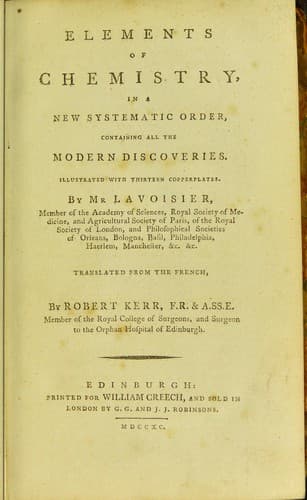
Elements of Chemistry,: In a New Systematic Order, Containing all the Modern DiscoveriesLavoisier, Antoine Laurent
Science
Elements of Chemistry,: In a New Systematic Order, Containing all the Modern Discoveries
Lavoisier, Antoine Laurent
Chemistry -- Early works to 1800
To explain the use of the fourth tube, I must enter into some
discussions. Suppose the vessel LMNO, Pl. VIII. Fig. 1. full of water,
and the jar A partly filled with gas, and partly with water; it is
evident that the weights in the bason P may be so adjusted, as to
occasion an exact equilibrium between the weight of the bason and of the
jar, so that the external air shall not tend to enter into the jar, nor
the gas to escape from it; and in this case the water will stand exactly
at the same level both within and without the jar. On the contrary, if
the weight in the bason P be diminished, the jar will then press
downwards from its own gravity, and the water will stand lower within
the jar than it does without; in this case, the included air or gas will
suffer a degree of compression above that experienced by the external
air, exactly proportioned to the weight of a column of water, equal to
the difference of the external and internal surfaces of the water. From
these reflections, Mr Meusnier contrived a method of determining the
exact degree of pressure to which the gas contained in the jar is at any
time exposed. For this purpose, he employs a double glass syphon 19, 20,
21, 22, 23, firmly cemented at 19 and 23. The extremity 19 of this
syphon communicates freely with the water in the external vessel of the
machine, and the extremity 23 communicates with the fourth tube at the
bottom of the cylindrical vessel, and consequently, by means of the
perpendicular tube st, Pl. IX. Fig. 4. with the air contained in the
jar. He likewise cements, at 16, Pl. VIII. Fig. 1. another glass tube
16, 17, 18, which communicates at 16 with the water in the exterior
vessel LMNO, and, at its upper end 18, is open to the external air.
By these several contrivances, it is evident that the water must stand
in the tube 16, 17, 18, at the same level with that in the cistern LMNO;
and, on the contrary, that, in the branch 19, 20, 21, it must stand
higher or lower, according as the air in the jar is subjected to a
greater or lesser pressure than the external air. To ascertain these
differences, a brass scale divided into inches and lines is fixed
between these two tubes. It is readily conceived that, as air, and all
other elastic fluids, must increase in weight by compression, it is
necessary to know their degree of condensation to be enabled to
calculate their quantities, and to convert the measure of their volumes
into correspondent weights; and this object is intended to be fulfilled
by the contrivance now described.
Public-domain text, read in full here on John Shaqi.
Reviews
Reviews
No reviews yet
Be the first to share your thoughts on this work.
Elsewhere in the archive
Join the Discussion
Join the discussion
Sign in to leave a comment or review.
Sign InorCreate an account